
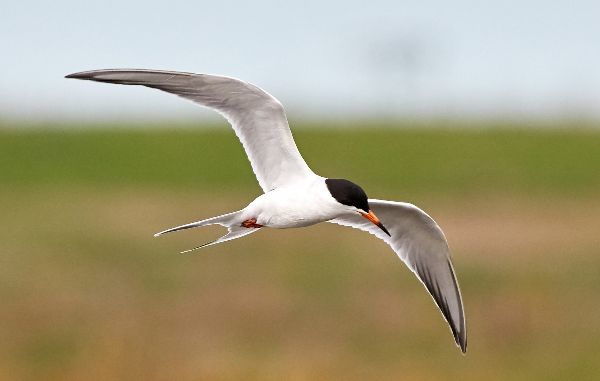
Fall is still more a hope than a promise across much of the nation, but the first signs are starting to appear.
When shad swarm to the surface on inland lakes and rivers in fall, terns, gulls and other birds usually associated with saltwater become freshwater visitors for a time.
That time is beginning right now across the Southeast as young shad reach a size that makes them attractive to terns, small white birds adept at skimming minnows from the surface. Forster’s terns, in particular, are common fall visitors to freshwater lakes and reservoirs across the South.
As the baitfish grow and fall progresses, gulls often join the feeding activity on big lakes across the South. When colder weather arrives farther north, American white pelicans and loons also become increasingly common on Southern reservoirs, where shad can be an important part of their diet.
Birds that feed on baitfish are particularly interesting to anglers because their arrival often marks some of the best fishing of the year for largemouth bass, stripers, white bass and other shad-loving species.
Gamefish drive bait toward the surface, where birds can attack from above. The resulting commotion can keep the shad concentrated near the surface, sometimes putting them within easy reach of both predators.
It’s obviously not a good time to be a shad, but it’s a good time to be an angler, because diving birds function as fishy beacons that can be seen from far away. When there’s a whirling tornado of gulls and terns, perhaps with cormorants or loons nearby, there’s a good chance baitfish are concentrated in the area. And if gamefish are pushing them to the surface, the fishing can be spectacular.
When the feed is on, it’s mostly a matter of getting within casting range and throwing anything that looks remotely shad-like into the melee—topwaters, jerkbaits, swimbaits, you name it. One of my favorites is the flutter spoon, which seems irresistible to largemouths, spotted bass and white bass among other species.
Wherever shad are abundant in Southern reservoirs, this is the time of year to start watching the sky for a bird bite. From late summer through fall and into early winter on some lakes, the birds can lead you to some of the best schooling-fish action of the year.
New Products: NOCO Genius Gen5X3
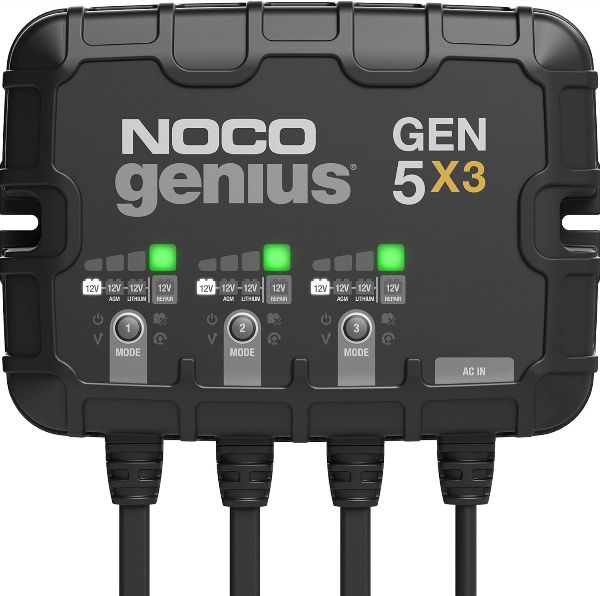
Those of us running three or more batteries aboard eventually get tired of transferring charger connections from one battery to another and bite the bullet for a multi-battery charger. With today’s high-draw electronics, including multiple sonar-GPS units and forward-scanning sonar, recharging daily is pretty much standard practice.
The NOCO Genius GEN5X3 fits the way many modern fishing boats are wired: one battery for starting, one for electronics and a third (or more) for the trolling motor. It charges three batteries independently, so you plug in once and let it do the work.
At five amps per bank, the GEN5X3 is designed for overnight recovery after a normal day of fishing. Each bank is isolated, so a depleted trolling battery doesn’t draw current from a fully charged starting battery. Its multi-stage charging helps bring batteries to full charge before switching to maintenance mode, reducing the risk of chronic undercharging or overcharging.
Five amps is plenty for a typical 12-volt deep-cycle battery, though large-capacity batteries or several consecutive hard fishing days will require more charging time. Anglers needing rapid turnaround may want a higher-output charger. For everyone else, the slower charging rate is a reasonable tradeoff for an overnight, set-it-and-forget-it system.
Installation is straightforward. The compact unit is sealed and vibration resistant, and its IP68 waterproof rating provides protection from rain and spray, although mounting it in a dry location is still preferable. On our bass rig, it fully recharged three Group 31 12-volt batteries overnight after several days of hard fishing.
There’s no app or remote display—just status lights and automatic operation. The GEN5X3 isn’t the fastest charger available, but for three-battery fishing boats, it’s a solid, durable and affordable way to simplify charging; https://no.co/gen5x3.
ResQFlare II: A Flare That’s Not a Flare
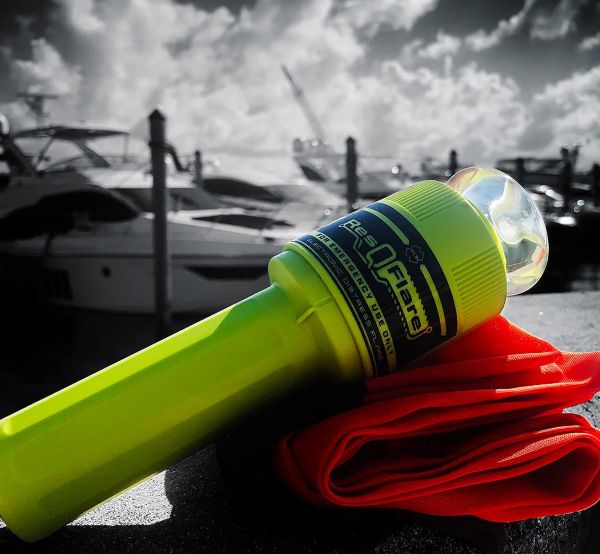
Pyrotechnical flares are dangerous, undependable and short-lived—they tend not to work after a year or two of storage in the damp compartments of a boat. They don’t want to start sometimes, and when started they’re short-lived, with most lasting only a couple minutes before burning out.
Also, they burn at extreme temperatures (over 1,000°C), which makes it easy to start a fire that you don’t want aboard. They expire 42 months after manufacture, in terms of fulfilling the visual distress signal requirement for boats, and if you’re not careful how you store them, they won’t last that long. And when they’re out of date, you are supposed to treat them as hazardous waste in disposal.
ACR has a way better solution. Their floating ResQFlare II is a battery powered, waterproof strobe that flashes out a brilliant “S-O-S” signal that the company says is visible for up to 6 miles. There’s no ignition problems, it’s not sensitive to dampness or salt corrosion and it runs for up to 20 hours on two “C” alkaline batteries.
If you have to abandon ship—as you might in case of fire or if the boat fully sinks—you can take the flare with you—a wrist lanyard guards against loss, and it floats.
The ResQFlare II costs more than a pack of flares—it’s $79.95, versus around $40 for three flares--but buy it once and you’ve got a visual emergency signaling device for life—just replace the batteries every 5 years and you’re good to go.
Details at www.acrartex.com.
– Frank Sargeant, Editor, The Water Wire