
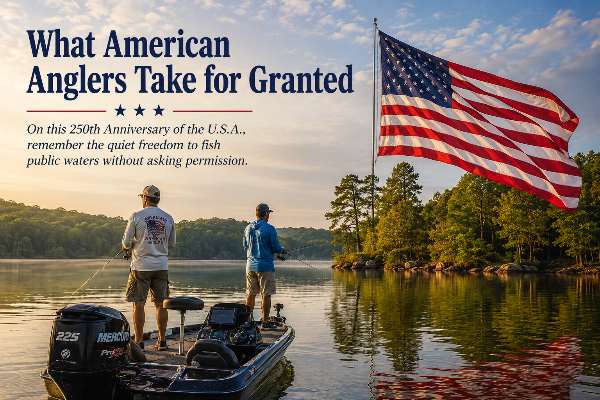
Ask an American angler where they’ll fish on this 250th Anniversary of the U.S.A. and the answer is likely to be someplace close to home: a river outside town, a reservoir managed by the state or TVA, a stretch of coast open to anyone with a license. The assumption is simple and deeply ingrained—in nearly all public waters across the nation, angler access is not only allowed but often encouraged.
That assumption does not apply in many parts of the world.
Across much of Europe, recreational fishing operates under a very different set of expectations. Rivers, streams, lakes, and even some coastal waters are frequently controlled by landowners, estates, clubs, or syndicates. Access is limited, often expensive, and usually requires advance permission. The idea that someone could pull off the road, walk to a riverbank, and legally fish is foreign in many places.
American anglers rarely stop to consider how unusual their system is. Yet the openness of U.S. fishing waters represents one of the clearest practical differences between American and European outdoor traditions—and one rooted in history, law, and cultural resistance to privatization.
In countries such as United Kingdom, freshwater fishing rights are typically tied to land ownership. Rivers may appear public, but the fishing itself belongs to whoever owns the riverbank. Access often requires purchasing a day ticket from an estate, joining a fishing club, or leasing a beat for the season. Well-known chalk streams can command hundreds of dollars per day, placing them effectively out of reach for most anglers.
A similar structure exists in Germany, where fishing rights are controlled by local associations known as Vereine. Membership is required, waiting lists are common, and visiting anglers face limited access even when water is abundant. In France, anglers must navigate a layered system of permits, local associations, and water classifications that vary by region and species. The water may be scenic and plentiful, but access is neither automatic nor inexpensive.
Don’t even ask about prime salmon river access in the Nordic nations unless you’ve got a grand a day or more to spend.
The cost of fishing in these systems reflects their structure. European anglers often pay multiple fees—national licenses, local permits, club dues, and daily access charges—before making a single cast. By contrast, most American anglers gain access to vast networks of rivers, lakes, and coastal waters with a single state-issued license costing far less than a tank of gas.
This contrast raises a reasonable question: why did pay-to-fish systems become standard overseas, while they never took hold in the United States?
The answer lies partly in history, and partly in philosophy. Early American law rejected the European model that treated wildlife and water as privileges of land ownership or aristocracy. Instead, fish and wildlife were recognized as public resources, held in trust by the state for the benefit of all citizens. That principle—often referred to as the public-trust doctrine—established that no individual or estate could claim ownership of wild fish simply because they controlled the shoreline.
As the nation expanded westward, this idea hardened into policy. Rivers were highways, fisheries were food sources, and access mattered. States assumed responsibility for managing fish populations, while leaving the water itself open to the public wherever navigable or designated for public use. Note that’s “navigable” water, though—trout streams running through private ranches are not public water unless you can float them.
European countries took the opposite path. Fishing rights followed property lines. Management authority rested with landowners or associations rather than centralized agencies. Over time, fishing became something you rented rather than a public right.
The American approach carried long-term consequences. Open access required regulation to prevent overharvest, which in turn led to the development of professional fisheries management. License fees funded science, enforcement, and habitat work. Anglers became stakeholders rather than customers, supporting the system that sustained their access.
Our system is not without stress. It can easily result in overfishing. And waterfront property owners sometimes take affront and Billy Bob catching their pet 5-pounder from under their dock.
Yet our underlying framework still assumes access in most cases, with management as necessary to preserve the resource.
As the United States heads into another Independence Day, the contrast is worth noting. Fireworks and flags aside, one of the most tangible expressions of American independence is the ability to fish public water without asking permission. It is a quiet freedom, rarely advertised, and often taken for granted.
For anglers who value the freedom to fish, the lesson is clear. Public access is not an accident, and it is not guaranteed. It exists because earlier generations rejected the idea that fishing should belong only to those who could afford it. That legacy remains one of the defining features of American recreational fishing—and one worth remembering as we celebrate this special Independence Day.
– Frank Sargeant, Editor of The Water Wire
Frankmako1@gmail.com