
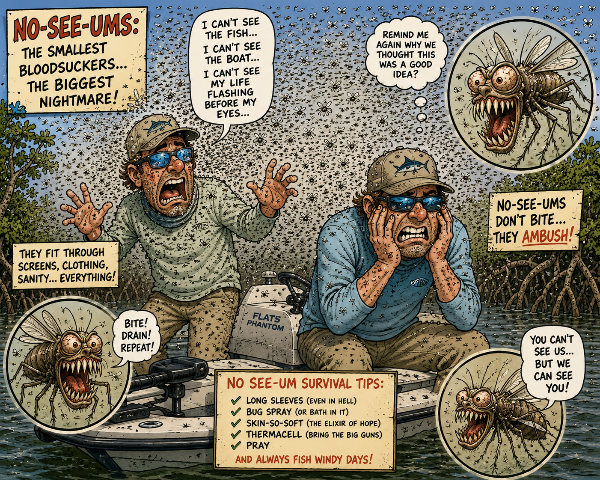
God should just admit He made a mistake in creating no-see-ums and wipe them out, in my opinion, along with black flies, buffalo gnats and time-share salesmen.
No-see-ums are one of the few creatures on Earth that can make a hard-core angler cry “Uncle!”
Actually, what we really cry can’t be printed here due to Internet protocols.
They are so small you can’t see them coming, yet somehow they arrive by the thousands, locate the one square inch of exposed skin between your glove and shirt cuff, and make you question every life decision that brought you to that mangrove shoreline.
The name itself sounds harmless. “No-see-um.” How bad can something you can’t see hurt you?
The reality is a flying grain of sand armed with a hypodermic needle and a personal grudge against fishermen.
And they never travel alone. Coordinated attacks can involve numbers that seem destined to peel away every inch of exposed skin. They can slip through ordinary window screens and find the one exposed spot you forgot to cover.
Right now is prime time. No-see-ums are at their worst through late summer and early fall along much of the Gulf Coast, Florida and up into the Carolinas. In South Florida, especially around mangroves, backcountry flats and estuaries, there is really no true off-season.
The places where anglers find paradise are the same places no-see-ums call home: The Everglades. Florida Bay. The Ten Thousand Islands. The Indian River Lagoon. Gulf Coast bays. Atlantic mangrove creeks.
You get redfish, snook, tarpon and endless sunshine.
You also get clouds of tiny insects that apparently believe human beings were placed on Earth primarily as a buffet.
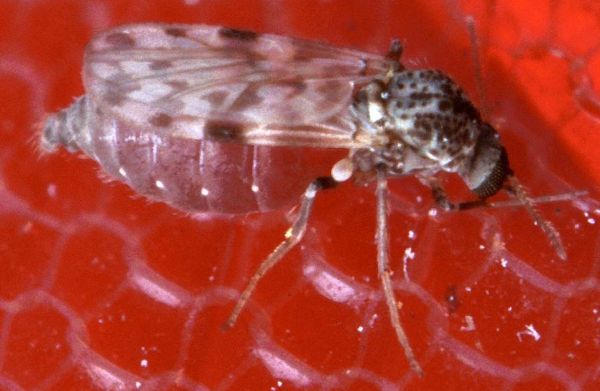
The frustrating thing is how many of them there are. A boat drifting quietly along a mangrove edge can suddenly become surrounded by a swarm that seems to appear from nowhere. If you cast your lure into the mangroves and try to go in there after it, you take your life in your hands. The no-see-ums and the mosquitoes form a coalition of the willing to drain you like a thousand tiny vampires.
But mosquito at least has the courtesy to announce itself. That high-pitched whine gives you warning. A no-see-um is a silent assassin. It attacks with a stinging bite, disappears and leaves behind an itch that can last for days.
Scientists call them biting midges. Anglers call them much worse things.
They are weak fliers, which is why wind is your friend. A stiff breeze can make a miserable day tolerable because these tiny insects struggle in moving air. But when conditions are calm, humid and windless—especially early morning, late afternoon or around dusk—they can be relentless.
They breed in moist organic areas such as marsh edges, mangrove mud and wet shorelines—the same environments that produce some of the South’s best fishing.
The good news is that you don’t have to surrender your boat keys and become an indoor person until winter.
A little preparation goes a long way.
Dress Like You’re Going to War
Long sleeve shirts are a must—many light, stretchy fabrics are cool but protective, and they also prevent sunburn, so are doubly useful.
A hat with a brim helps protect your face, and a neck gaiter pulled up around the collar leaves fewer attack points. (If you’re fishing the Glades in the dead of summer, you may actually need a fine mesh headnet—believe me, they get every bit that bad!)
Gloves are another overlooked defense. Many anglers spend thousands on rods, reels and electronics but leave their hands uncovered—the exact place no-see-ums love to find. Lightweight fishing gloves also protect your hands from the usual cuts and scratches of fishing.
Repellents Really Help
The most effective repellents contain ingredients such as DEET, picaridin or oil of lemon eucalyptus. Use them according to label directions. Where there are no-see-ums there are always tons of mosquitoes, too, and the DEET definitely helps with them, though not always with the no-see-ums.
Many anglers also swear by permethrin-treated clothing. Unlike sprays applied to skin, permethrin bonds to fabric and can provide longer-lasting protection when used properly.
And then there is the legendary Florida solution:
Skin-So-Soft.
For generations, boaters have carried bottles of Avon Skin-So-Soft in tackle boxes, coolers and console compartments. Whether its reputation exceeds the science is still debated around marina docks, but thousands of outdoorsmen swear it helps. (Guys, don’t slather up with this stuff and then walk into an Everglades City bar on a Friday night. Just sayin . . . .)
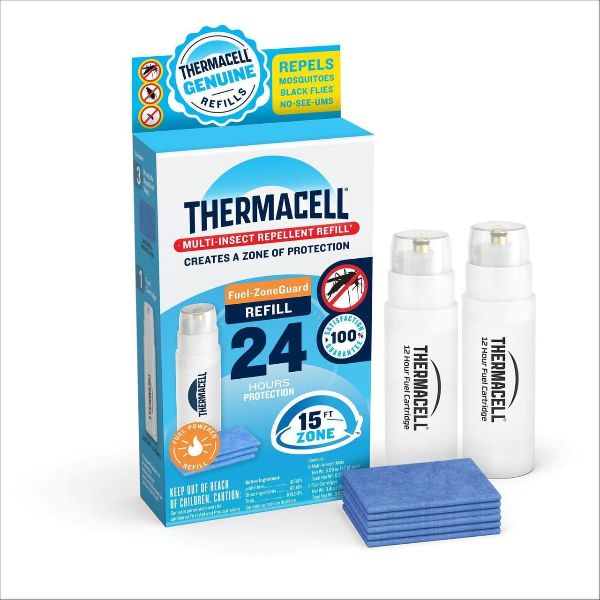
Portable bug-control devices such as Thermacell units can really help create a more comfortable space around a boat or campsite, more effective than any wearable potion, in my experience. But for no-see-ums, stronger formulas and careful placement matter because these insects are more persistent and often more abundant than mosquitoes.
Timing and Location Matter
No-see-ums are not equally bad everywhere or all the time.
Wind is your ally. Fishing an exposed shoreline on a breezy day can be far more pleasant than sitting in a calm mangrove creek.
Early morning and evening are often the worst periods. If conditions allow, planning your fishing around times when insects are less active can make a big difference.
Remember, though, that the best fishing spots are often the places no-see-ums love too. Mangrove shorelines, backcountry creeks and shallow flats hold both fish and insects.
Go prepared and you’ll find them bearable, so long as the fishing is good.
– Frank Sargeant, Editor of The Water Wire