
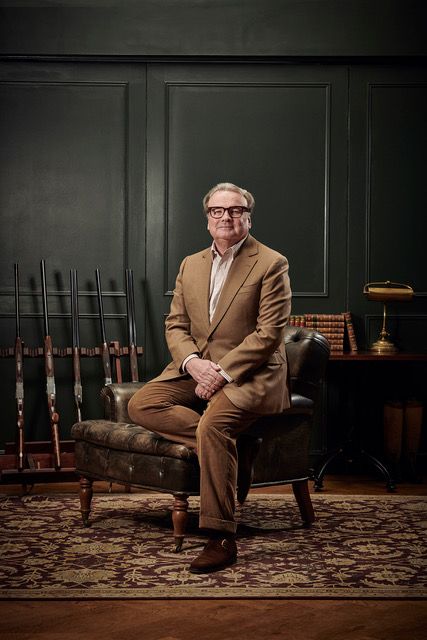
Looking back over his family and their company’s 500-year history doesn’t occupy a lot of Pietro Gussalli Beretta’s time. When he does look back, it isn’t for guidance, it’s as a reminder that his work today should honor the thousands of people who built the Beretta name and reputation over five centuries. Beretta’s 500th anniversary was, he explained, “meant to recognize the workers, craftsmen, managers and employees who contributed to Beretta’s development across generations.
His concerns are the immediate and future for the more than twenty companies under Beretta Holding’s rather large umbrella. And Beretta Holdings has a decidedly wider focus than many who think they “know” the Beretta name might imagine.
Most Americans think shotguns or the M92 pistols carried by tens of thousands of U.S. troops before the military’s latest small arms change when they hear “Beretta.”
That Beretta is only a portion of Beretta Holdings, the Luxembourg based holding group formed - by Pietro Gussalli Beretta - in 1995.
Beretta Holdings, with its portfolio of firearms, ammunition, optics, defense technologies, clothing and accessories, is, in fact, the world’s largest firearms company, with 2025 revenues of $1.90 billion dollars and an EBITDA of $287 million (15.1%)

Those worldwide holdings are divided roughly 60/40 between commercial and military properties, respectively. Europe remained its primary revenue growth engine for 2025, accounting for 55% of revenue. North America contributed approximately 32%, with the rest of the world accounting for 12%.
In our discussion, he told me that military sales had historically represented about twenty percent of the business. Today, he said, the defense opportunity was much larger, primarily due to increased defense spending across many regions. That growth, he told me, was driven by historical circumstances, not strategic changes. Circumstances, he said, that present both challenges and market opportunities for the industry.
Beretta Holdings growth has come, primarily via acquisition, not historical circumstance.
How, I asked, does the Beretta family (Holdings remains a family-owned business) decide when a company was worth acquiring? Is the decision based on history, production or performance expectations?
“We’ve acquired quite a few companies,” he explained, “always with different reasons, mostly related to the product. When we made the Beretta holding, the desire was to be with a wider range of product to satisfy our customers, whether they were hunter, the shooters, the policeman or the military. The strategy was always to try to see some complementary product.”
“One of first,” he recounted, “was SAKO in Finland. This was easy to decide, because for many years we had tried to make rifles inside our doors…with not a lot of success. We needed to go in the rifle business because it was absolutely complimentary with us. And Nokia, the owner at the time, wanted to sell SAKO, so I tried to buy the company, and we did.”
Other companies, he explained were acquired for geographic reasons, helping to expand Beretta Holdings into different geographic areas. One company, Holland and Holland, was for more than just their product. Holland and Holland, he said simply, was different.
“They have a fantastic product, even in their clothing,” he explained, “it’s very elegant, very British. Different from what we do in Italy or elsewhere.”
“They have concentrated for many, many years, always on the same products. Always on the same finishments- every detail must be finished. They polish by hand, the accuracy of the barrels, and they make very small numbers of guns and every part and piece of their products are made in-house. They take a long time.”
How long? “To celebrate the acquisition,” he said, “I wanted a pair of double barrel rifles to remember the acquisition. It was for myself, you understand?”
He got his pair of double guns. But explained, “they took more than two years…but the quality is amazing.”
The opportunity to have a conversation wasn’t one I took lightly, so I felt it proper to ask one final question: what would he want our readers to know about Beretta Holdings?
“I should like them to have a picture of Beretta Holdings,” he said, “with Italian roots, but an international approach…a company looking for the future worldwide.”
The conversation with Pietro Gussalli Beretta can be read in its entirety in today’s QA Outdoors. If you’re not a subscriber, you’ll miss out (here’s a link to our subscription page.)
As always, we’ll keep you posted.
— Jim Shepherd