
Back in the olden days -- the 1990s -- violent crime in America peaked in about 1992, then began a steady, decades-long decline. Aside from a man-made spike thanks to the George Floyd/defund-the-police/"restorative justice" blip in 2020/2021 (which some of us are still dealing with), America hasn't seen crime rates this low in a century outside of a few blue urban enclaves that carefully cultivate their own special environments where crime is actively tolerated, if not encouraged.
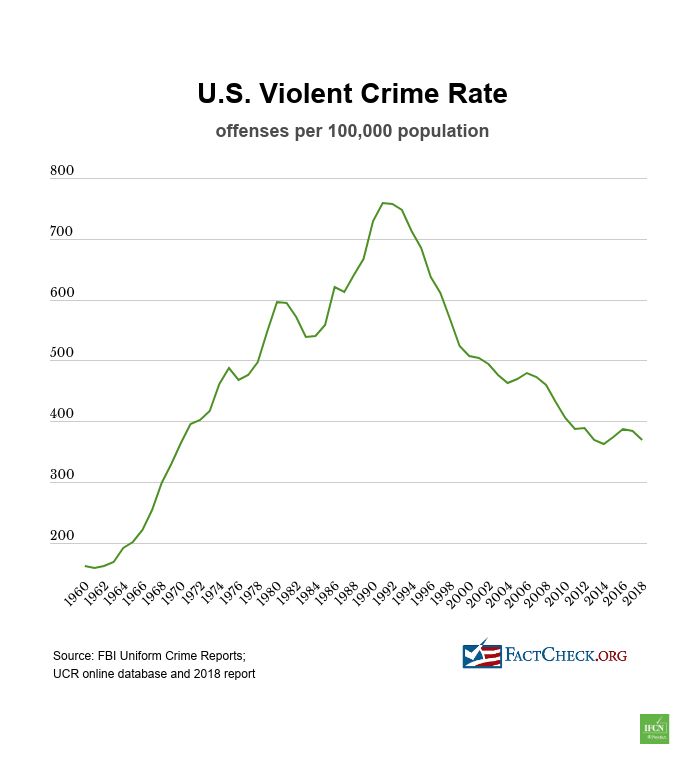
So when violent crime rates started to fall after about 1992, people took note of the change in course. One of those people was New York Times reporter Fox Butterfield. In 1997, he wrote an article entitled, Punitive Damages; Crime Keeps On Falling, but Prisons Keep On Filling. This great work of jernalizm started like this:
IT has become a comforting story: for five straight years, crime has been falling, led by a drop in murder.
So why is the number of inmates in prisons and jails around the nation still going up? Last year, it reached almost 1.7 million, up about seven percent a year since 1990.
The question is not merely a trick quiz, because the costs of running America's constantly expanding prison system -- now more than $30 billion a year -- have begun to impose an enormous burden on state governments.
Butterfield couldn't help but clutch his pearls over the mystifying paradox of society paying the cost to incarcerate so many criminals while crime was falling. It apparently never occurred to the Harvard graduate that crime had been falling precisely because those people were behind bars.
You can be sure, however, that many of his readers saw the (staggeringly obvious) relationship between bad guys behind bars and safer streets across the fruited plain.
In the years that followed, he took a well-deserved, constant ration of shit from those who saw no paradox at all between less crime and higher prison populations. It resulted in the Wall Street Journal's James Taranto coining a term for a failure to recognize such blindingly obvious relationships.
He (along with Michael Graham) called this the Butterfield Effect. It's a syndrome that seems to afflict many in the media who fail to (or won't) see obvious correlations that manage to hit the rest of us right between the eyes.
The latest manifestation of the Butterfield Effect kicking in comes to us from our good friends at Michael Bloomberg's anti-gun agitprop outlet, The Trace, where Aaron Mendelson has written this classic: By the Numbers: Shootings Decrease, But Gun Sales Are Up.
Quoting numbers from the frequently discredited Gun Violence Archive, Mendelson notes that . . .
Shooting deaths and injuries remain at historic lows in the United States, continuing the trend seen in Q1 and in recent years.
Data from the Gun Violence Archive shows 6,458 shooting deaths, and 11,781 shooting injuries in the first six months of the year. Both represent the lowest number since 2015.
That's good news, of course, and something many of us have noticed. But it baffled Mendelson, so he consulted...an expert . . .
As crime data analyst Jeff Asher told The Trace in May, there are several dimensions to consider:
One, it’s happening everywhere, so it’s probably not local factors.
Two, it happened at a time of decreased police presence. We have fewer officers everywhere.
Three, it happened at a time when we haven’t solved the root causes of crime. It’s not like we fixed poverty and education. Those are still obviously major issues.
Four, the country is still awash in guns. Gun sales are still at elevated levels.
Five, there hasn’t been some major breakthrough in policing efficiency. Clearance rates plunged in 2020. Now they’re rising again, but that probably has more to do with the fact that murder is falling than anything else.
About those guns . . .
An estimated 7.3 million firearms have been sold in the United States — about 4.5 million handguns and another 2.8 million long guns. That would be enough to arm every single resident of Tennessee.
The numbers represent a 2.7 percent increase in gun sales through six months compared to 2025. This marks the first time in six years that we’ve seen an increase in sales.
While the uptick is notable, the raw total is still lower than any year from 2020 to 2024.
But like Butterfield before him, The Trace's Mendelson doesn't (or refuses to) see the possibility that the expansion of gun ownership in America -- along with making it far easier to carry one legally -- might be at least a contributing factor in the historic reduction in crime.
As the old saying goes, an armed society is a polite society. Not only have gun sales expanded significantly in the post-COVID/Floyd era, but the number of states that have eliminated any barrier at all to carrying a gun has expanded to 29. Add to that the Supreme Court's recent ruling that delivered a body blow to some of the worst Bruen-inspired carry barriers.
But seeing a relationship between more guns and less crime -- as some have for years -- doesn't come easy for those who toil in Master Bloombergs fields of hoplophobic hype. In fact, even pointing out such a possibility could be hazardous to your economic health (employment-wise).
But on the plus side, this is what results in such lulz-worthy, Butterfieldian analyses that fail to acknowledge the gun-toting elephant in the room. So it's a win-win. We'll just continue to mercilessly ridicule laugh at them when they publish this stuff.
– Dan Zimmerman