
Throughout the first Trump administration we were repeatedly told America had declined in Europe's eyes. The world's only superpower was no longer the bastion of democracy it once represented.
Somehow, an unapologetic American President, one who deigned to tell NATO member nations to meet their defense spending requirement, had soured relations with America's fellow NATO members.
During Biden’s term as President—his first, and Jimmy Carter's second if inflation and malaise are the measuring stick—the message to Europe was clear, and something along the lines of “The U.S. has a sacred obligation to defend you, regardless of whether or not you decide to invest in your own defense.”
That’s not a direct quote, but a fairly accurate paraphrasing.
Biden, of course, was lauded by the mainstream media for repairing relations with NATO, after Trump had so callously damaged those relationships.
As soon as Trump’s second term began, the handwringing of mainstream media pundits returned. This time with near breathless reports of how Trump was severing relations with long-time NATO allies.
For 10 or so years now we’ve heard nothing but stories about Europe’s growing disdain for the U.S., to the point that maybe some of those allies might seek a new alliance partnership.
The reports of anti-American sentiment of European nationals and leaders has become so loud that the average American would not be faulted for thinking Europe hates us. That the countries that relied on our wealth and military might to get them through two world wars and the Cold War now want little to do with us.
Or so it would seem.
Enter Futbol
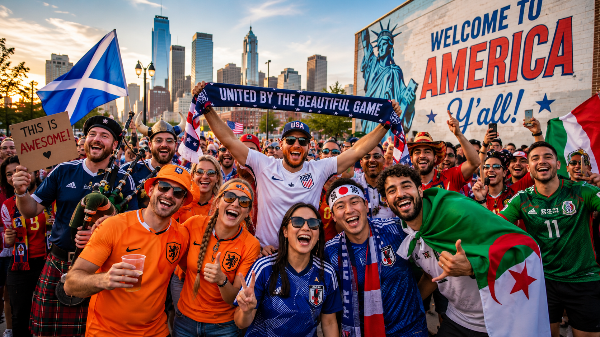
Like many, I suspect, I had at most only a passing interest in the FIFA World Cup being hosted here in the U.S., as well as in Canada and Mexico.
The U.S. is not a futbol country. We are a football nation. And as such, we don’t do real well when it comes to qualifying let alone competing in World Cup competition. We did qualify in 2022 and made it to the round of 16 before being knocked out by the Netherlands.
Our best performance recently was making it to the quarterfinals against Japan in 2002. Before that we placed third back in 1930. In the period from 1954 to 1986 the U.S. failed to qualify for nine straight World Cup tournaments.
Futbol—or as we like to call it, soccer—isn’t our strong suit.
However, this year there was a real sense of optimism, despite as a host nation getting the participation trophy equivalent for qualification. U.S. fans rallied around the team and the U.S. Men’s National Team’s win in the round of 32 over Bosnia-Herzegovina drew 33.5 million viewers in the U.S., making it the most-watched soccer broadcast in U.S. history.
That is until Monday night in Seattle when the U.S. versus Belgium match drew 36.8 million viewers.
Unfortunately, the USMNT did not have its best performance against Belgium. The 4-1 loss brought the legions of enthusiastic U.S. soccer fans back down to earth—and fast.
So, why all the popularity?
First, it’s the U.S. team and American sports fans are nothing if no patriotic when it comes to backing any U.S. team in any sport. The fact that we’re the underdog in the sport of futbol only further fuels that ‘us versus the world’ fanaticism.
Second, and maybe the most important, is the fact that when the world came to America to support their teams they fell in love with the United States.
Social media blew up with viral stories of the Tartan Army (Scotland) drinking Boston dry and putting traffic cones on the heads of statues. Then, out of appreciation and respect, the main Boston bar they frequented, The Dubliner, closed the day England faced Ghana at nearby Gillette Stadium.
When the Algerian national team selected Lawrence, Kansas, as its base camp during the World Cup, the town “adopted” the team. To make the team feel at home, and as a way to thank them for choosing Lawrence, the community studied Algerian culture and learned both Arabic and French phrases. They even packed viewing parties to support their international guests.
The Dutch flooded the streets of Dallas, Houston, and Kansas City in waves of bright orange, and the Orange Army mobilized whenever the Netherlands played a game.
The Vikings from Norway brought their Viking Row, a synchronized chant and rowing motion done in large groups, particularly in the stands after the Norway team won. Norwegian star Erling Haaland visited Wild Bill's Western Store in downtown Dallas and single-handedly caused a run on “Y’all Can Kiss My Dallas” t-shirts.
Their website currently reads “Inventory on the way.”
Then there are the fans from various nations discovering Waffle House, Buc-ee’s, Bass Pro Shops, SEC stadiums, Texas barbecue, gun shops and ranges, and a myriad of other everyday experiences we take for granted. And Ranch dressing is about the be a thing overseas.
And, of course, there is the German soccer fan freddyLA7 (his social handle) known simply as Freddy. Entire social media accounts have overtaken the algorithm with their commentary on Freddy’s exploits as he travels across America and Canada.
The U.S. took on the role of World Cup Host seriously, and to heart. So many stories on social media feature foreign tourists being welcomed by the communities they visited. The TikTok and Instagram feeds are littered with visitors trying American foods for the first time only to have the cost of the meal picked up by the restaurant owner or another patron.
This level of hospitality shown foreign teams and their fans has been the single greatest public relations initiative America could ever have hoped for. And it’s one that flies in the face of the carefully constructed narrative of a Europe/NATO that is distancing itself from the United States.
The people of Europe that traveled to America have been received warmly and will leave the U.S. with vast numbers of new friends.
The drumbeat about strained relations with Europe/NATO that we’ve been hearing for the past 10 to 11 years is more about Europe’s leaders sharing their disappointment in a U.S. President that doesn’t care to write anymore blank checks.
Their snarky comments about America and its (Republican) leaders look more like the tantrums of petulant politicians—frustrated they no longer have Washington's unconditional support (and money)—when juxtaposed to the comments, photos, and videos of their citizens enjoying their time in the Land of the Free.
We would do well to remember that the next time the mainstream media tells us otherwise.
– Paul Erhardt, Managing Editor, the Outdoor Wire Digital Network