
From boatloads of Nigerian gold to a “recently departed acquaintance in the Republic of _____” there are no shortage of schemes designed to hustle anyone who’s gullible enough to think it’s really possible to get rich by giving someone you don’t know all your banking information.
The latest cons range from using screws to make you think you’ve hung up the gas nozzle when pumping gas to using RFID-readers to steal your confidential credit card information.
Then there are the now time-worn, but surprisingly still effective internet cons that involve fake invoices that look exactly like “real” invoices. They can come from any company and cover everything from your “Annual Software Protection Plan” to extensions of your car warranty-“regardless of the year, make or mileage.”
Sometimes, however, the scammers are guilty of “failing to read the room.” They’ve used the dark web to acquire your basic information (it’s for sale there, trust us), done a bit of work to see some of your browsing history, and generated what they believe to be an invoice that’s designed to set their hustle into motion.
The hustle isn’t to get you to pay the invoice, that’s only the hook. The hustle involves the operator you talk with when you call to argue the invoice isn’t legitimate. The operator’s job is simple: use conversation and concern to obtain your banking information. It sounds legit, they “need your basic banking information (name on account, routing and account numbers) to “make certain the un-authorized funds are promptly redeposited into your account.”
If/when they get the information, they’ll likely tell you they will “test” the transaction engine via a debit and re-deposit of $1 to verify the account information. They’ll assure you the entire process is secure end-to-end, then tell you to expect your refund in 24-48 hours. They’ll probably give you a toll free number to call if there’s an issue.
You hang up, relieved to have headed a scammer off at the pass. That relief passes the instant you check your balances and find out they’ve not only scammed you for that amount, they’ve essentially cleaned out your account.
Sounds ridiculous, doesn’t it? But people are scammed out of hundreds of millions of dollars every year by similar hustles.
Fortunately, the scammers don’t alway know enough about the customer, the company or the alleged product purchased to realize they’ve blown the whistle on themselves. That happened to one of our folks earlier this week when an authentic-looking invoice arrived from Apple. As a longtime Apple user, the invoice looked absolutely authentic. But when we saw what was supposedly purchased and pre-paid, we burst out laughing.
Rather than waste words explaining, we’ll just let you see the invoice. Be prepared to chuckle.
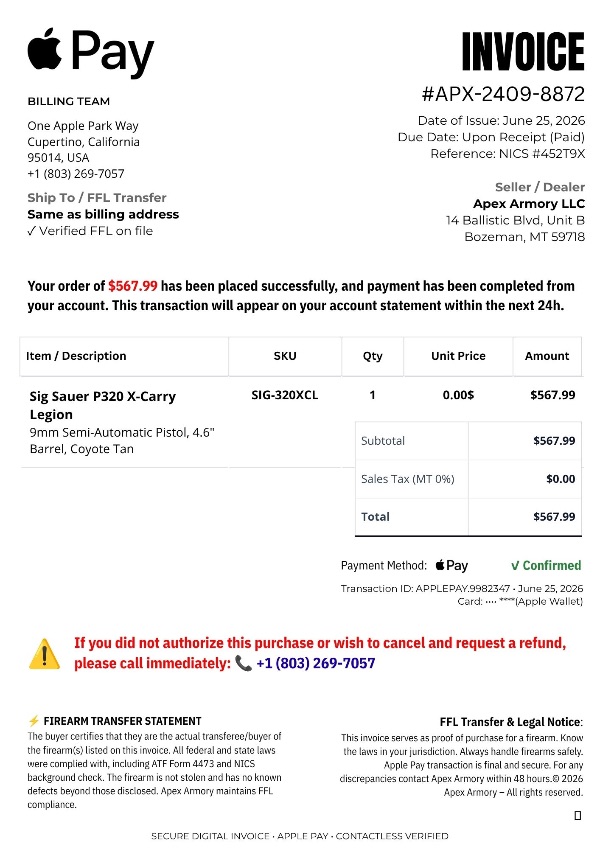
Apparently scammers really do believe it possible to buy guns online in America. For some of us (especially those of us who were young adults during our bicentennial celebrations) that was once true. But those days, like those bicentennial youth, are long gone.
We'll keep you posted.
– Jim Shepherd