
First, before anybody gets upset, ‘The Lord's Work’ is being used euphemistically.
Because nothing makes manufacturers, distributors, retailers, sales reps—and ultimately customers—take the Lord's name in vain faster than bad product information.
Every marketing manager has lived this nightmare.
The wrong product photo is on a retailer's website. A discontinued optic somehow keeps showing up in online catalogs. Barrel lengths don't match. Calibers are wrong. Somebody copied specifications from an old spreadsheet three years ago and now that information has propagated across half the internet.
Meanwhile, the manufacturer's phone starts ringing.
Ask me how I know.
Actually...don't. Let's just say I've invoked the Son of God on more than one occasion—usually on a hobby horse, thanks to Michael Bane—over a missing product image or an outdated specification sheet.
The reality is that for decades—if not all eternity—one of the biggest problems facing the shooting sports industry hasn't been designing products. It's been keeping product information accurate once those products leave the manufacturer's marketing department.
A company introduces a new rifle, suppressor, optic, or ammunition line. Product descriptions get emailed to distributors. High-resolution photos get sent through Dropbox or WeTransfer. Somebody updates a spreadsheet. Somebody else changes a website. Sales reps build presentations. Retailers grab whatever photos they can find online.
Then the fun begins.
Somewhere along the way, the wrong image gets used. A specification doesn't get updated. A dealer copies information from another dealer. Before long, there are half a dozen different versions of the same product floating around the marketplace.
Everybody loses.
Manufacturers spend time correcting bad information instead of launching new products. Distributors dedicate resources to maintaining product databases that someone else has already built. Retailers wonder whether the specifications they're publishing are actually correct. Sales rep groups become the cleanup crew, trying to answer questions that never should have existed in the first place.
That's the problem the National Association of Sporting Goods Wholesalers (NASGW) believes it can solve.
Its answer is VAULT.

At its simplest, VAULT is a centralized product information database built specifically for the shooting sports industry. Instead of manufacturers emailing photos, spec sheets, logos, marketing copy and technical information to dozens of different business partners, everything resides in one manufacturer-controlled location.
Publish it once. Update it once. And everyone who has permission accesses the same information.
It's one of those ideas that's so simple you almost wonder why nobody built it years ago. According to NASGW President Kenyon Gleason, that's exactly the point.
Quoting an old proverb in his June message to members, Gleason wrote, "One of the best times to plant a tree is 20 years ago. The next best time is today."
VAULT is one of those trees.
It's an investment in industry infrastructure that won't necessarily make headlines, but it could quietly improve the way business gets done for years to come.
It's open to any manufacturer, not just NASGW members, and it’s manufacturers that may realize the biggest immediate benefit.
Instead of maintaining countless versions of product descriptions, technical specifications, photography, logos and marketing assets across multiple business partners, manufacturers become the single source of truth. When a specification changes, or a better product image becomes available, the update happens once. Everyone downstream receives the current version.
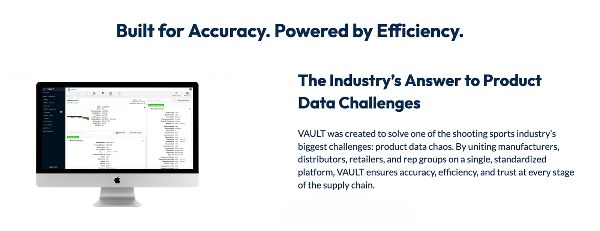
That alone could eliminate countless emails and customer service calls. And to be clear, after manufacturers, customer service staff will be the big beneficiaries from the standardization of product information VAULT will deliver.
Distributors also stand to save enormous amounts of time.
Every major wholesaler maintains product databases containing hundreds of thousands of SKUs. Historically, much of that information has been recreated internally—even though another distributor down the street may be doing exactly the same work.
That's duplicated effort.
VAULT allows distributors to spend less time building product catalogs and more time doing what distributors actually do—selling products, managing inventory and supporting retailers.
Retailers—all retailers—will have access to VAULT for a very small annual fee. And it's the retailers that may appreciate VAULT even more than manufactures and distributors.
Whether they're updating an e-commerce site, building a weekly flyer, creating social media posts or printing shelf tags, finding accurate product information has traditionally involved searching manufacturer websites, distributor portals, old emails and image libraries.
Sometimes you find the right information.
Sometimes you don't.
With VAULT, retailers know they're pulling approved descriptions, specifications and photography directly from the manufacturer instead of hoping whatever they found on Google is current.
Sales representative groups probably deserve their own paragraph, because their job is introducing products—not verifying specifications.
When reps represent multiple manufacturers, keeping presentations, catalogs and digital assets current becomes a full-time job. Having one place to retrieve approved product information means they spend less time organizing files and more time calling on dealers.
That's a win for everyone.
Perhaps the most important thing VAULT provides isn't storage—it’s consistency.
Every stakeholder—from the manufacturer introducing a product to the retailer selling it—is working from the same information. The same product descriptions. The same photography. The same technical specifications.
Consumers benefit, too.
When a customer researches a firearm, optic or box of ammunition online, they shouldn't find conflicting information depending on which website they're visiting.
Accurate information builds confidence, and confidence sells products.
Gleason closed his June message with another thought worth remembering. "We don't plant trees for ourselves," he wrote. "We plant them for those who come after us."
VAULT feels very much like that kind of project.
Like NASGW's SCOPE market intelligence platform before it, VAULT isn't designed to create excitement because it's flashy. It's designed to make the industry work better.
Sometimes innovation isn't another rifle, another optic or another cartridge.
Sometimes it's building the infrastructure that helps every one of those products reach the marketplace with the right information attached.
That's the kind of work the entire industry can appreciate.
– Paul Erhardt, Managing Editor, the Outdoor Wire Digital Network