
All the leaves are brown (all the leaves are brown)
And the sky is gray (and the sky is gray)
I've been for a walk (I've been for a walk)
On a winter's day (on a winter's day)
I'd be safe and warm (I'd be safe and warm)
If I was in LA (if I was in LA)
California dreamin' (California dreamin')
On such a winter's day
– The Mamas & the Papas
What does it mean to be safe in LA? In 1965, when The Mamas & the Papas released their iconic song "California Dreamin'," Los Angeles was a very different place.
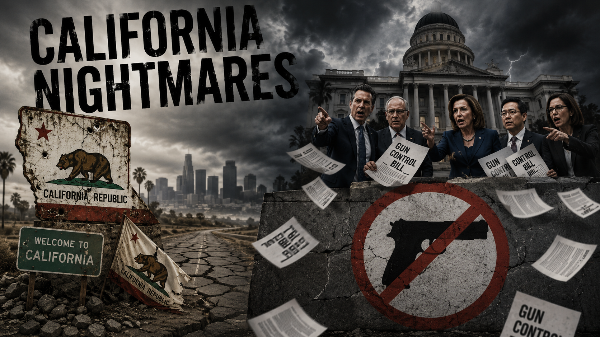
Today, what supposedly makes one safe in Los Angeles is determined by a cadre of predominantly left-wing ideologues who control the state legislature. Their latest attempt to make the streets of Los Angeles—and those across the rest of the Golden State—safe comes in the form of a law that outlaws a gun.
The prohibition on the Glock pistols is based on the State’s reclassification of the semi-automatic handgun as a machine gun.
That’s a MACHINE GUN, for those not reading closely enough.
Are Glock pistols machine guns—or, more accurately, machine pistols—other than the Glock 18? No. The Glock 19, 17, 43, 43X, 34, and so on, and so on, are not machine anything.
They are semi-automatic firearms. You pull the trigger once and it goes bang once. And it doesn’t go bang again until you pull the trigger once more. That’s how semi-autos work.
However, thanks to an illegally manufactured and illegally sold, aftermarket device called a Glock switch, also known as an auto sear (though it’s not the design used in the G18), California’s Democratic state leadership has banned Glock pistols solely on the basis that they could be altered—again, illegally.
This has nothing to do with Glock the manufacturer. Yet, because somebody, somewhere, somehow made a device to alter the function of the company’s federally licensed and highly regulated legal product, the California Legislature, with the help of the Governor, has banned Glocks beginning July 1.
There are two problems that stem from this legislative maneuver, assuming it can withstand the legal challenges being mounted by the NRA, the Second Amendment Foundation (SAF), and the Firearms Policy Coalition (FPC).
California Copycats
The first problem is the most obvious. Blue state legislatures will follow California’s lead and push through their own bad laws designed not to protect the public but to reduce the number of guns available to law-abiding citizens.
They will simply cut and paste the California legislation, add a line or two to give it that home-town flavor and, voilà, the Glock ban is coming to a state near you.
In his New York Post opinion piece, California’s Glock ban sets stage for nationwide gun control, John Mac Ghlionn noted California’s unofficial but widely accepted role as “the ultimate legislative laboratory for aggressive gun control.”
Thanks to its size, its political importance—both in terms of votes and fundraising—and its market share, which at one time was 11% of all firearms sold in the U.S., what happens in California finds its way to the rest of the country.
California's vehicle emissions standards are perhaps the best-known example of the Californication of the rest of the country.
Gun control has always been about eliminating the number and types of guns available to people to purchase, where and how those guns can be used, and lately how those guns must be stored in homes.
All of this is intended to force gun owners to conform to a government's increasingly restrictive view of how the Second Amendment should be exercised.
The result, as Mac Ghlionn points out, is: “It leaves the Second Amendment looking more like a limited-time retail promotion than an unalienable right.”
California's ban is about addition by subtraction, increasing gun control by eliminating one of the largest handgun product lines in America.
Setting a New Standard
The second, and more concerning aspect of the California Glock Ban—not that for gun owners this isn’t concerning enough—it also gives governments a new standard by which products can be banned, companies brought to heel, and citizens controlled.
If a legally made and sold Glock pistol is banned because of what alterations might happen, then it opens the floodgates to attack any product based solely on a possible negative outcome completely out of the hands of the manufacturer—not unlike suing gun makers for the criminal misuse of their product by others.
This kind of legislation will be used to force companies to alter a product’s design—which only works until someone develops another workaround.
Or, it will be used to pressure manufacturers into financial settlements. Money that will go into a state-controlled fund and be doled out to address the very issue that arises from either bad actors or idiots.
The infamous Tide Pod Challenge comes to mind. In California’s way of thinking, Tide should have known kids on TikTok would start eating Tide Pods, and therefore needs to answer for egregious misuse of its product.
Considering California's track record in how it uses taxpayer dollars to solve problems such as homelessness and high-speed rail, one can assume that any fund created could best be described more as a slush fund.
The irony here is that if California punishes Glock for something entirely out of its control, shouldn’t California legislators and bureaucrats face similar punishment for funneling money to NGOs and cronies whose purpose appears less focused on solving homelessness or building high-speed rail than on enriching politically connected interests?
– Paul Erhardt, Managing Editor, the Outdoor Wire Digital Network