
The gold rush is on.
With the $200 tax stamp gone, and processing times dropping to as little as 30-some hours, key barriers to suppressor ownership have all but disappeared, opening the door to first-time buyers.
Based on Form 4 suppressor numbers through the first quarter of 2026, however, it’s less an opening of the door and more the opening of the floodgates.
The American Suppressor Association (ASA) reported that through all of 2025 the ATF processed only 731,623 Form 4s. In just the first three months of 2026 the ATF has received 532,319 Form 4s for suppressors—or 72.8% of the 2025 volume.
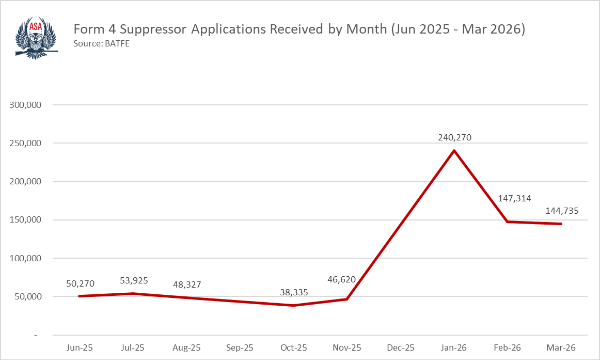
Now, that doesn’t necessarily mean 532,319 suppressors sold. According to ASA Vice President Owen Miller, the tax stamp elimination changed the math.
“In years past, the number of Form 4s received for suppressors was a pretty accurate barometer of commercial sales as one Form 4 = one transfer to a non-licensee. This year we will see an increase in other types of transfers (used/secondary market, transfers of individually registered suppressors to consolidate collection into a trust, etc.”
“I think the total number will still be fairly accurate but not as accurate as it was,” he cautioned.
Keeping Up With Demand
During the NRA Show in Houston I spoke to several exhibiting suppressor companies, and all pointed to what can best be described as an overwhelming increase in demand.
Chris Graham, owner of Yankee Hill Machine, said that by the first quarter of this year the company had already sold a third of the suppressors it sold during all of 2025.
"We're looking to increase this year's production by at least 25%,” Graham said.
Like many suppressor makers, Yankee Hill Machine does all their own manufacturing, which Graham points out is both a blessing and a curse. “Sometimes it slows us down, but we can also control exactly what we're making.”
Keeping up with the surge in demand is something most companies are facing.
Ron Norton at Inland Manufacturing (distributed by MKS) said the “response from the public has been tremendous,” adding that the January surge wiped out inventory throughout the distribution channel.
It’s a similar story at Rugged Suppressors where Callie Baldwin, Marketing Director, said simply, “We can't keep our nine millimeter and our .22s in stock.”
She attributes the demand to the consumer preference for .22LR and 9mm ammo but also to the wide availability of firearms in these calibers that come from the factory with threaded barrels.
“We're out of stock, and the back orders on the 9mm, the .22 and the sub 9mm are incredible because so many people have come out with some really good platforms. We've seen growth in all of our products, but those are the ones that I just see the backlog getting bigger and bigger.”
When I asked Ben Staub, CEO for Jaguar Silencers, how business was in the first quarter he replied,” It's gone gangbusters for us.”
Staub explained that in 2025 Jaguar, a brand that launched only three and a half years ago, doubled sales, thanks in-part to the fact Jaguar manufactures everything in-house. Their business also includes OEM work for other suppressor makers.
For this year, along with increased OEM business, Staub says “our own Jaguar Silencers line is probably going to be about four times the sales of 2025.”
Interesting Trend
As new customers enter the suppressor market at a rapidly increasing rate, demand from existing suppressor owners continues.
In the past, many would buy one suppressor capable of handling multiple calibers, opting to move it from one gun to another rather than go through the cumbersome—and costly—process of buying another can.
That is changing.
Baldwin noted that Rugged is seeing customers move toward a “one suppressor for one gun” mentality—especially with rifles, describing the customer’s attitude as, “I just don't want to switch it around anymore. I'm gonna get a dedicated suppressor for this guy.”
Ryan Stratton, Director of Sales for SilencerCo, confirmed they’re seeing the same thing.
“Somebody comes up interested in buying their first suppressor. They’re looking for one can that works across multiple hosts and calibers,” Stratton explained.
“Then we see those people come back and say, ‘I really want a dedicated pistol can. I really want a dedicated rifle can. I want a dedicated rimfire can.’ Their second and third purchases become more caliber- or host-specific.”
The low prices, increasingly greater selection from existing and new silencer companies, and the fast processing times of the still required NFA paperwork means current suppressor owners are more likely to expand their collection.
And the trend of rifle makers embracing suppressors to meet consumer demand continues. Just as Ruger committed to threading the barrels on all of its American Rifle Gen 2 models, so too has Henry expanded its offerings to meet the growing need.
At the NRA Show George Thompson, Director of Product for Henry, explained how the company has “gone all in following what's going on in the suppressor market, now that they've become much more accessible for people.”
“The demand has grown drastically in that market, and lever guns are a naturally great suppressor host, so it only made sense for us to fully embrace that and come out with a bunch of new models to support it,” Thompson said.
For the traditionalist have no fear, Henry hasn’t threaded its core classic models, only adding more to address the “very noticeable shift towards the suppressor ready guns.”
New Players Entering the Market
Several of the conversations with exhibiting suppressor makers at the Houston show included mentions of the increasing number of new suppressor makers, or existing companies adding suppressors to their product portfolio—all looking to cash in on a market that it nowhere near its peak.
Silent Steel USA is one of those new companies, but they are not new to suppressors. For the last 10 years they have been focused on the military market in Europe, from their headquarters in Finland. According to Kim Jensen, VP Sales & Marketing, it wasn’t until this past October that the company began selling direct from their website, and in January expanded sales through the commercial channels.
While it’s still early days in the commercial market for Silent Steel USA, Jensen says, “We are overwhelmed with the amount of momentum and the achievement that we've had so far.”
Another new entrant is EchoCore Suppressors out of North Conway, N.H. Owner Chris Mudgett, and 19-year veteran of the industry, said they began a soft launch to dealers in October of 2025 and began shipping in December.
Though new, EchoCore offers six models from .22LR to multi-caliber options. Their 5.56 models took first and second place in that category at the 2025 Silencer Summit, an open industry testing event. Thanks to that, and their exclusive distribution partnership with Silencer Shop, EchoCore has already exceeded its initial sales projections for all of 2026 and is now working through backorders.
In January, FN America announced its first-ever purpose-built rifle suppressors, which would soon be available to U.S. consumers. The FN QD Series of rifle suppressors are 5.56x45mm and 7.62x51mm caliber forward-vented suppressors, purpose-built for the SCAR platform.
Of course Sig Sauer has been in the suppressor market for a few years now, and most recently Ruger partnered with Dead Air Silencers on the RXD line of co-branded suppressors which they introduced at the 2025 NRA Show in Atlanta.
Bergara entered the market this year with their BTi30 suppressor. And, Lyman unveiled the Sonicore line of suppressors at SHOT Show.
We can expect any number of new suppressor announcements this year, and probably next as well.
Some exhibitors mentioned the new entrants into the suppressor market with a subtle hint of skepticism, suggesting these brands may be here today but gone tomorrow.
Chris Graham noted that Yankee Hill Machine has “been in business for 75 years, so we've kind of seen a lot of things come and go,” and compared the suppressor surge to the AR market boom under Obama.
“During the Obama administration, when he started talking about bans, suddenly everybody and their brother was making AR15s, or barrels, or bolts, or support materials. A lot of them were just kind of jumping on the bandwagon, and they could make some money on it. And, you know, three, four or five years later, they simply just don't exist.”
Though I could not confirm this stat before our deadline, one insider told me there are approximately 150 new suppressor companies that have entered the market on or about January 1, 2026. And to Graham’s point, they expect 100 of those will not be around at the conclusion of the year.
The Rush Is On
Truth of the matter is that right now it’s the California Gold Rush and the suppressor market is attracting its own 300,000 “forty-niners.”
But unlike gold, suppressors aren’t scarce, but the manufacturing and engineering know-how to succeed in the market—beyond the initial rush—is.
For right now, it’s a free-for-all of sorts.
I spoke to Silencer Shop during the NRA Show. They are the largest suppressor distributor, and thanks to nearly 7,000 dealers and a growing number of their easy-to-use (ask me how I know) kiosks in a third of those locations—and counting—Silencer Shop accounts for anywhere from 60 to 70 percent of all suppressors sold.
They put the first quarter of 2026 into perspective.
“It was our biggest quarter to date, for the company. We didn't really know what to expect. January was huge, but we're still seeing that new normal, basically two times higher than what we were expecting from this time last year.”
As for the rest of the year, Silencer Shop sees the market moving away from the traditional slow-down of Q2 and the summer.
“This year seems like there's a lot of new buyers, and the time between people buying their first suppressor and second, and third, suppressors has also shrunk quite a bit. There’s a bunch of new people coming into the market, and they're buying more cans.”
Silencer Shop estimates that they are seeing somewhere between 75 and 80 percent of purchases coming from repeat buyers—and that includes those who bought their first suppressor earlier this year.
For each new suppressor owner the market is impacted two ways. The first is a second purchase, even a third. And the other way those new owners are driving sales is through simple word of mouth.
Once a friend shoots your new suppressor, and learns how easy—and fast—the process is, they are more than likely to want to buy their own can.
As of April 10, 2026, there are now 5,998,065 silencers registered with the National Firearms Registration and Transfer Record (NFRTR). At the close of 2024 that number was 4,419,578.
– Paul Erhardt, Managing Editor, the Outdoor Wire Digital Network