
Over the last fifty years, a relatively small group of lures—spinnerbaits, crankbaits, soft plastics, jigs, swimbaits, blade baits and topwaters—have accounted for an overwhelming share of largemouth bass caught in North America.
That raises an interesting question: what if you stripped those classics down to their essential traits and rebuilt them into a single lure? Not a gimmick, not a garage Frankenstein, but a computer-generated design based on what bass have consistently responded to across waters, seasons, and pressure levels.
The result would look familiar—but oddly strange.
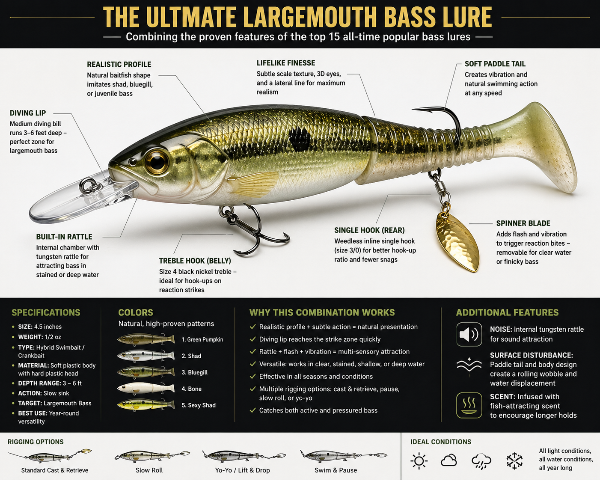
I asked ChatGPT to design this ultimate, one size fits all lure. And it came up with something that looks a lot like several lures already out there, yet a bit different.
At first glance, this hypothetical lure would be modest in size, somewhere around four inches. Large enough to interest big fish, small enough to avoid spooking pressured bass or excluding smaller forage profiles. It matches juvenile shad, small bluegill, young perch, maybe a fleeing herring in open water. Bass eat by opportunity more than preference, and this size lives squarely in the opportunity zone.
The body would be a hybrid—soft plastic, but not floppy. Think supple enough to breathe and flex, firm enough to hold shape and transmit vibration. A segmented baitfish profile would give it natural movement on a straight retrieve, while added ribbing would displace water and hold scent. Bass are primarily sight feeders, but they also seem to sense movement in other ways, perhaps with their lateral line. The ribbed body adds that dimension, perhaps, without relying on oversized appendages.
The most productive lure colors of all time tend to share a common theme: natural bases with strategic contrast. The core color would be green pumpkin or olive—something that works everywhere—but broken by a pearl or bone belly and a hint of chartreuse or gold flash. In clear water, it looks real. In dirty water, it’s visible. Add a subtle UV finish and it holds its profile longer in low light, which is when a lot of big bass feed.
The tail is a soft flexible paddle designed to thump at slow speeds and stay stable when burned, just as with many well-known swimbaits. That single feature alone borrows from swimbaits, spinnerbaits, and buzzbaits all at once. At depth, it would send out pressure waves. Near the surface, it would hopefully leave just enough disturbance to suggest something fleeing. Crank it fast and you’ve got a runaway shad. Twitch it slow and you’ve got an injured shiner or bluegill.
Depth control is critical, and this is where the lure quietly cheats. A small, integrated diving lip—not a deep crank bill, just enough to force the nose down, combined with neutral buoyancy or a little negative—would allow the bait to run anywhere from 2 to 8 feet where largemouth seem to spend a large amount of their lives. A slow sinker might also work as an FFS bird dog.
Internally, it would carry a rattle chamber, maybe tungsten, though I’ve always thought that the difference between tungsten and other weights is designed mostly to profit lure makers rather than to catch more fish. But some sort of noise that gets a bass looking your way can help most of the time.
Rather than multiple trebles, the Chat design proposes a single treble forward on the belly, which in my observation is where 90 percent of bass get hooked on hard lures. The back treble on many lures only serves to catch weeds—and your fingers when dehooking the fish. This lure also has a single hook coming out the top of the tail, which would avoid weeds for the most part and possibly catch some short strikers.
If you were looking for an existing lure that comes close, Berkley’s Powerbait Nessie, Cullshad or Chop Block are all in the zone in size, shape and action, and all are scented.
Google Gemini’s Perfect Lure
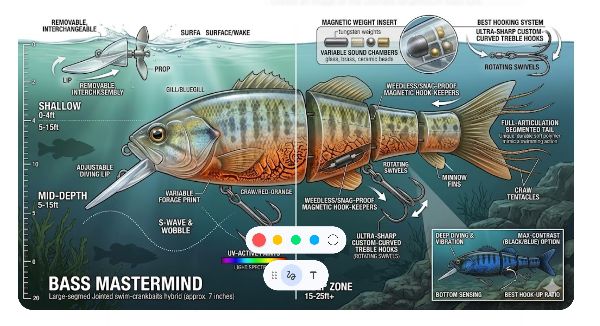
Surprisingly, when I asked Google Gemini to do the same thing, it produced a lure that’s eerily similar to ChatGPT’s solution, though it looks more like a bluegill than a shad or shiner.
There’s an adjustable diving lip, a very good idea for covering various depths without a lure change, and a magnetic keeper for the rear treble might keep make that one less likely to snag weeds.
The four-segment body would give the lure a snake-like swimming action, maybe similar to some of our favorite BBZ lures. A magnet weight system would make the lure easy to cast long distances, presumably.
Similar existing lures include the Bucca Baby Bull and the Savage Gear Live 3D Bluegill among others.
Claude: Not Ready for Prime Time
I also asked Claude for a solution to the ultimate bass lure. Here’s what it came up with.
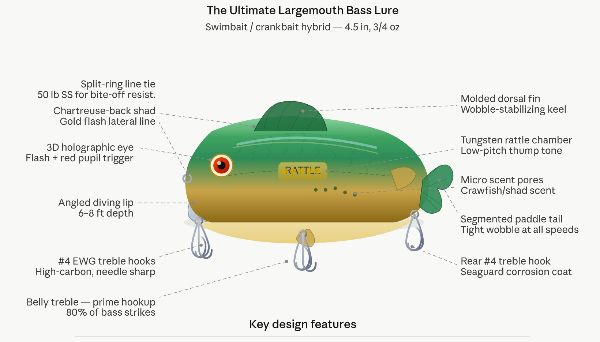
While Claude builds remarkable Codex systems and can easily write your novel or your screen play for you, it does not appear to have much future in lure design.
In all honesty, the Claude lure looks a lot like a lure my youngest son designed - - - when he was in the 3rd grade.
If you’re looking for the best possible bass lure design, Claude is sort of a clod—ChatGPT or Google Gemini seem more capable of channeling their inner mad lure scientists, at least in present configurations.
– Frank Sargeant, Editor of The Water Wire
Frankmako1@gmail.com