
One of the most interesting new firearms introduced during the 2026 SHOT Show wasn’t just new—it was different in how it came to be. That pistol was the Beretta B22 Jaguar Metal Competition.
What makes the B22 Jaguar interesting isn’t simply the gun itself—which is no knock on the pistol, because it is a very cool, very capable .22LR—but the process behind its development and the unlikely voices that helped shape it.
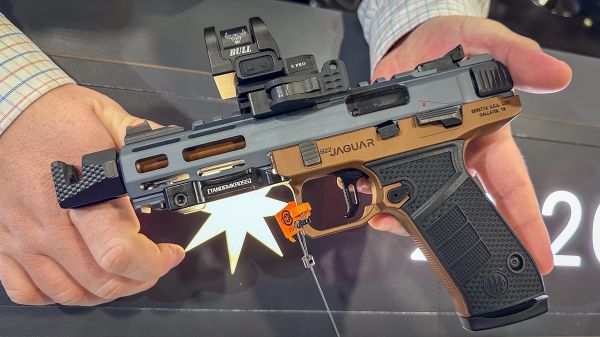
Leaving the NSSF Press Room up on the fourth floor, I ran into Rick Leach of the Scholastic Shooting Sports Foundation (SSSF), which oversees the Scholastic Clay Target Program (SCTP) and the Scholastic Action Shooting Program (SASP).
When Leach mentioned a new Beretta pistol for competition, my immediate assumption was some variant of the Beretta 92, which in all honesty I had no real interest in, considering it’s a 50-year-old platform.
Leach quickly corrected me, pointing out the new pistol was a .22LR. Once again, my mind jumped to another older Beretta design—the Neos—which is no longer available.
After successfully burying the lede, Leach told me Beretta had reached out to SSSF for direct input from SASP coaches and competitors on an all-new .22LR pistol designed specifically for competition.
Interesting, for sure. Then he told me Beretta had taken about 80% of that feedback and incorporated it into the final design.
Now, that is very interesting.
European firearms makers aren’t exactly known for their reliance on consumer input from the American market—despite the fact we’re the largest firearms market in the world. One engineer for a noted German manufacturer dismissed negative feedback from a top-level U.S. shooter, responding with, “It is for me to design. It is for you to shoot.”
In another case, a German manufacturing executive outlined plans for introduce a $1,000 bolt-action rifle for what he referred to as the “Bubba market” in the U.S., only to be educated by his American counterpart that “Bubba” buys his rifle from Walmart and pays $350 for a gun that is every bit as accurate as his $1,000 rifle from Europe.
That “we know better than you” mentality still exists in pockets of the industry. So when a company like Beretta—backed by more than 500 years of firearms history—decides to build a new pistol around direct input from American competitive shooters, it’s a story worth telling.
Finding the Opportunity
As Logan Killam, Beretta’s Head of Tactical Segment and Senior Product Manager for Pistols and Pro Shop, explained it to me, the B22 Jaguar project started six years ago when the Beretta product management team identified a gap in the pistol market that offered Beretta an opportunity.
“Where is there a spot in the pistol market that hasn’t seen any innovation—anything meaningfully new—and is a space where Beretta could step in with a product that really plays to our strengths?” Killam said.
The answer, the Beretta team concluded, was competition rimfire.
“The .22 rimfire space really hasn’t had anything new or innovative in a long time,” Killam explained. “There are the Rugers, the Brownings, the Smith & Wessons—but those are old designs.
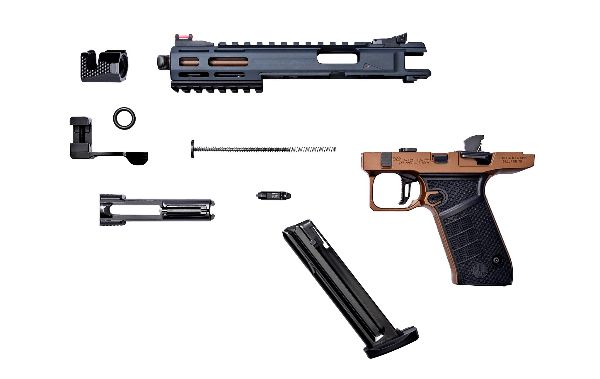
While those platforms have certainly stood the test of time, Beretta saw limitations that no longer matched how modern shooters train and compete. Legacy .22 pistols aren’t modular, aren’t easily upgradeable, aren’t particularly friendly to left-handed shooters, and often aren’t easy to service or disassemble.
“They’re just not great modern platforms,” Killam said, pointing to how centerfire pistols have evolved toward modularity and adaptability.
With that in mind, Beretta believed it could do better—and more importantly, do it differently.
“We had the engineering, the machining capability, and the expertise,” Killam said. “So we started down this long road of development.”
Learning From the People Who Compete
Rather than designing the pistol in isolation, Beretta made a deliberate decision to partner with experts already deeply embedded in competitive rimfire shooting.

That decision led Killam and the Beretta product team to Rick Leach and the Scholastic Action Shooting Program, where coaches and young competitors train at a volume and intensity that exposes weaknesses quickly.
At the same time, Beretta reached out to Tandemkross, an aftermarket manufacturer well known for performance upgrades to popular .22LR platforms.
The goal was simple: understand what actually matters in a modern competition rimfire pistol—and what doesn’t.
The First Shootable Prototype
Four years into development, Beretta arrived at a major milestone. In the summer of 2024, Killam’s team had a safe, shootable, one-of-one prototype ready for real-world evaluation.
They took that prototype to the Cardinal Shooting Center outside Columbus, Ohio, meeting with SASP coaches and competitors just ahead of their national championship.
“We brought out this single pistol in a very rough state, wrong colors, 3D printed hand-filed parts—but safe—and said, ‘All right, start playing.’”
Coaches and competitors were encouraged to disassemble the pistol, examine it, and shoot it. Feedback covered everything from ergonomics and balance to barrel length, weight distribution, and upper receiver design.
“Over the course of an entire day and night, myself and the engineers went through the whole gun with them—from muzzle to grip to magazine—and wrote down everything,” Killam said.
Not all of the feedback was gentle.
“They told us some of it was good, and that we were on the right track,” he said. “And they told us where we needed refinement—and where we were wrong.”
In the end, Beretta was able to incorporate the vast majority of that feedback into the design.
“That's the 80 percent that Rick was talking about,” Killam confirmed.
Raising the Reliability Bar
One of the most critical areas discussed during those sessions was reliability—a perennial challenge in .22LR pistols.
Talk to anyone in the development and testing of .22LR pistols and they will almost always mention CCI Mini-Mag as the ammo they use for testing. It’s consistent, reliable, and eliminates ammo variability as a testing variable.
But competitive shooters don’t always shoot Mini-Mags. Many run bulk-pack ammunition—and they run a lot of it.
That reality forced Beretta to rethink how it approached reliability testing.
“When we design a centerfire pistol, the expected service life is usually around 20,000 rounds before major upgrades,” Killam said. “That’s pretty much the industry standard.”
For rimfire competitors, however, 20,000 rounds is barely a warm-up.
“Some of these athletes are shooting 500 to 1,000 rounds in a single session,” Killam explained. “They might shoot 2,000 rounds in a weekend. That duty cycle is extremely high.”
Rather than relying on the traditional .22LR reliability standards—where a certain percentage of malfunctions is considered acceptable—Beretta chose a different path.
“We wrote the B22 Jaguar’s reliability spec to be similar to a centerfire pistol,” Killam said. “Because we’re going after the competition market. We don’t want an athlete losing a stage—or a match—because we didn’t hold ourselves to a stricter standard.”
That approach also extended to ammunition selection. Beretta tested the B22 Jaguar with a wide range of .22LR loads, including bulk and subsonic ammunition—not just Mini-Mag.
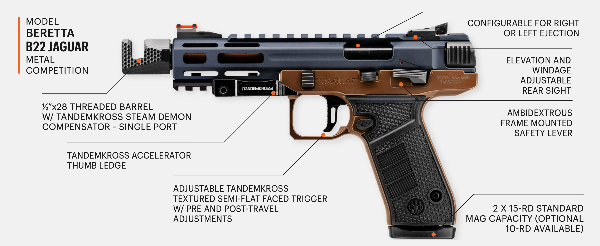
“We knew we had to look forward,” Killam said. “Suppressors are becoming more common. The base gun comes with a 1/2x28 threaded barrel, so it needs to run subsonic ammo. Dirty bulk ammo. The gun has to eat it all.”
Final Validation and Launch
After the initial SASP testing, Beretta spent the next six months refining the design, sharing progress with Leach and Tandemkross along the way. In 2025, a small number of pre-production pistols were sent back to SASP for final validation.
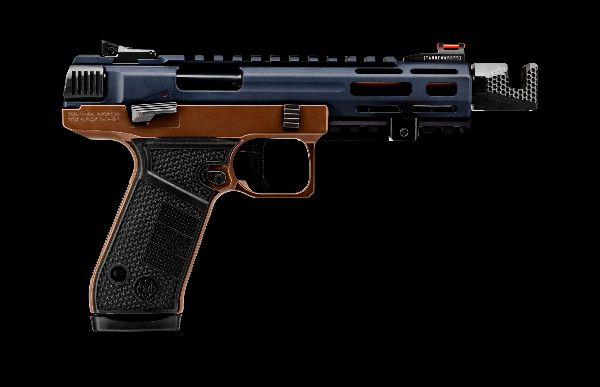
“Last summer, we went back to SASP with near-production guns,” Killam said. “Product management and engineering were there the entire time, watching students shoot and confirming that we were on the right track.”
Beretta even solicited feedback on pricing, asking competitors to help define the value of the features they had requested.
The B22 Jaguar Metal Competition carries an MSRP starting at $969, while the B22 Jaguar Tac Metal starts at $749.
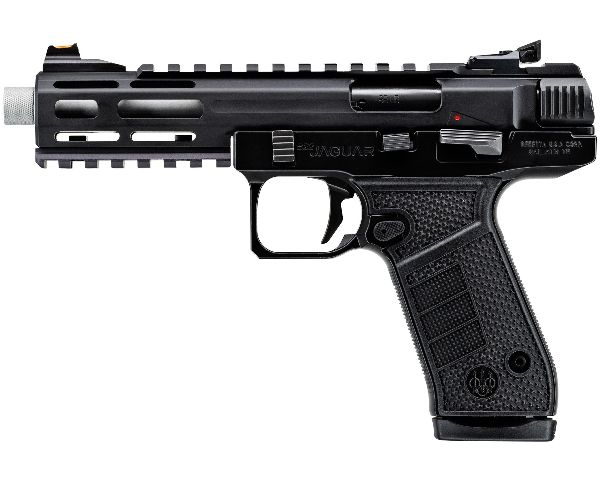
While the pistol debuted at SHOT Show, production begins in March, with shipments to dealers planned for April. The 2026 NRA Annual Meetings & Exhibits in Houston will serve as the B22 Jaguar’s full retail launch, with inventory available through Beretta’s dealer network.
Built Here, For Here
The Beretta B22 Jaguar Metal Competition is the result of a six-year collaboration between Beretta, SASP, and Tandemkross. It’s a pistol designed from the ground up for competition, built around the realities of modern training volume, modularity, and reliability.
And there’s one final detail worth noting.
While Beretta—the quintessential Italian firearms manufacturer—celebrates its 500th anniversary this year, the B22 Jaguar is a product entirely conceived, designed, engineered, and manufactured here in the United States—for the U.S. market and the U.S. shooter.
So if someone tells you European gunmakers aren’t paying attention to American shooters, you can tell them otherwise.
– Paul Erhardt, Managing Editor, the Outdoor Wire Digital Network