
While we were on our annual hiatus, things slowed, but didn’t stop. Manufacturers took advantage of the time between Christmas and New Years to catch their breath, inventory and perform needed maintenance. The rest of us tried to get ready for the annual January trade show sprints.
During our annual “dearth of deadlines” I took time and did some business and personal maintenance of my own. Before I closed the laptop for my annual “cold turkey break” (I close my computer after the last edition is readied for the next day and don’t open it until the following Monday) I expunged several thousand emails accumulated over the past 12 months, cleaned my to-do list (deleting things I listed, but had no intention of doing), and ruminated over some of the remaining news questions from 2025.
Over the course of a year, most unanswered news questions answer themselves.
A late-year visit to Glock’s headquarters in Georgia, for example, answered the question many keyboard commandos were asking, and simultaneously answering, (incorrectly): did Glock create their new Gen6 pistols in response to anti-gun politics?
The answer, explained in typical Glock fashion, was a resounding and irrefutable negative.
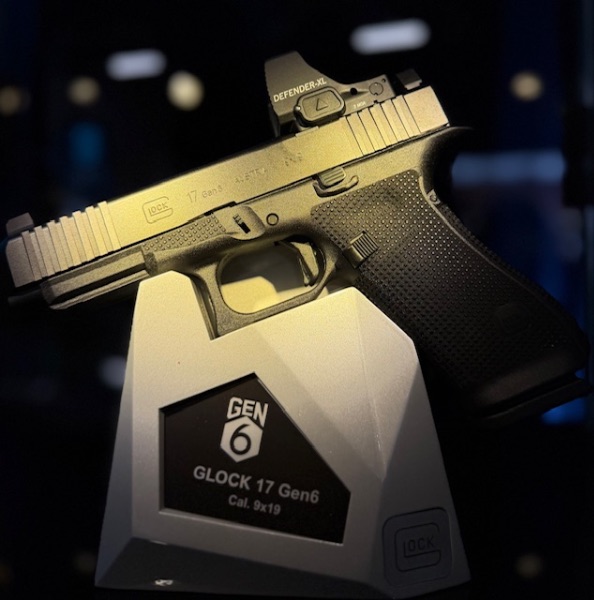
The new pistols were developed after rigorous testing at Glock USA and Glock Austria. Testing had begun even before the legislation being credited with causing a knee-jerk reaction was introduced.
Ruger’s unexpected announcement of the Red Label III shotgun was a double-barreled answer to a pair of questions. First, confirmation of the imminent return of the third version of their Red Label shotgun. The second barrel answered the question of a possible Beretta collaboration. It will not be a “Etichetta Rossa” collaboration with Beretta. It will be an entirely American collaboration with Connecticut Shotgun Manufacturing Company as their manufacturing partner.

That leaves a third question unanswered: why did Beretta holding buy such a significant chunk of Ruger stock if there was no definitive project(s) in mind?
That question’s still anyone’s guess.
A holiday conversation with Doug Ritter of Knife Rights brought a(nother) glaring government inconsistency to my attention. The Trump administration has argued for gun rights, going as far as to bring litigation against anti-gun regulations in several blue states.
But the same Justice Department filed a late-December appellate brief in the Fifth Circuit defending the 1958 Federal Switchblade Act that restricts interstate commerce in automatic knives and bans their possession on some federal and tribal lands. Knife Rights is seeking to overturn the federal ban on switchblades in Knife Rights v. Bondi. The plaintiffs say that switchblades should be protected under the Supreme Court’s Bruen decision.
The Justice Department’s appellate brief disagrees. The reasoning?
The assertion that switchblades are “well-suited to criminal misuse.”
That, apparently, is solely due to the blade being concealed in the handle until activated. It then quickly springs into action.
The logic disconnects when the Justice Department says folders, flippers and other one-hand operated knives are apparently fine, despite their blades being concealed -and deployed - in virtually the exact same manner, sans the spring feature.
The brief also holds the Federal Switchblade Act really isn’t a ban, because the law only regulates the “configuration and mode of a switchblade’s opening” - there are, they argue, plenty of other fixed blade and folding options available.
And that’s the rub.
As Ritter explains, “it’s like claiming the government hasn’t banned a book because you can still get other books.”
Ordinarily I’d call this just another example of the “I was for it…until…I was against it” logic used almost daily by politicians to defend their waffling on issues.
It’s troubling this time because it’s not a politician sticking a finger in the wind, it’s the Justice Department. Justice, I was taught, is always supposed to be blind, but never inconsistent.
And then there’s the latest chapter in the seemingly never-ending saga of the NRA. The National Rifle Association has now filed suit against the NRA Foundation, alleging the leadership of the 501(c)3 has “deteriorated the relationship with greater NRA” while “refusing to work with and assist the NRA” and continuing “to use our branding and intellectual property to raise money meant to support our operation.”
In a memo to staffers, NRA EVP/CEO Doug Hamlin explained there was “no choice but to take legal action against the NRA Foundation for violating and misusing the intellectual property of our organization” but stressed that the Foundation issue was “a leadership issue, and the bad behavior of a select few does not reflect on the organization as a whole.”
The leadership alluded to in Hamlin’s memo includes names familiar to anyone who followed the New York trial that exposed a myriad of financial abuses under former leader Wayne LaPierre.
As always, we’ll keep you posted.
— Jim Shepherd