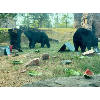
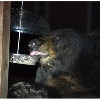
The Utah Division of Wildlife Resources provides guidance on preventing bear conflicts as black bears emerge from hibernation. DWR Game Mammals Coordinator Chad Wilson emphasizes securing food, maintaining clean campsites, and never feeding bears to prevent dangerous situations and unnecessary euthanization.
WILDLIFE
Oklahoma's Youth Spring Turkey Season opens April 11-12, with the regular season running April 16-May 16. The Oklahoma Department of Wildlife Conservation and Oklahoma State University are completing a $2 million research effort on wild turkey populations, while field reports from ODWC biologists indicate increased turkey numbers across most regions despite drought conditions in western areas.
A female grizzly bear translocated from Montana's Northern Continental Divide Ecosystem to Wyoming's Greater Yellowstone Ecosystem two years ago was recently photographed with cubs at her den site. The translocation, a partnership between Montana Fish, Wildlife & Parks, Wyoming Game and Fish Department, and Yellowstone National Park, demonstrates commitment to genetic diversity in recovered grizzly populations.
The Wyoming Game and Fish Department launched SCOUT, a specialized tool designed to analyze annual sage-grouse lek activity and build adaptive management strategies. The tool will be presented to the Sage-Grouse Implementation Team on April 8 in Casper.
The Wyoming Game and Fish Department distributed 8,500 blood collection kits to elk hunters in 2025, receiving 753 samples with 22 testing positive for brucellosis exposure. Jessica Jennings, Wildlife Health Lab manager, emphasizes hunters' critical role in tracking brucellosis prevalence across Wyoming's elk herds.
Idaho Fish and Game, in cooperation with the Coeur d'Alene Tribe, U.S. Army Corps of Engineers, and Idaho Trappers Association, completed the first year of a project relocating 11 fishers from the Clearwater Region to the Panhandle Region to augment populations and improve connectivity between isolated groups.
The North Dakota Game and Fish Department's 2025 bighorn sheep survey counted a record 378 sheep in western North Dakota's badlands, up 8% from 2024. Brett Wiedmann noted strong ewe numbers but poor lamb recruitment due to pneumonia, with veterinarian Logan Weyand attributing this to bacteria introduced in 2014.
As bears emerge from winter dens, the Wyoming Game and Fish Department urges residents and recreationists to take precautions to avoid conflicts. Large Carnivore Conflict Coordinator Brian DeBolt emphasizes securing attractants and staying alert while hiking, recommending the Bear Wise Wyoming program for education on bear safety and deterrence measures.
The Utah Division of Wildlife Resources provides guidance on handling baby birds found during spring. Jason Jones, Migratory Game Bird Coordinator, advises returning featherless birds to nests, leaving fledglings alone, and never feeding or taking baby birds home, as most are protected by state and federal laws.
Whooping cranes are migrating through North Dakota from Aransas National Wildlife Refuge in Texas as part of a population of about 550 birds. Sightings should be reported to U.S. Fish and Wildlife Service offices or the North Dakota Game and Fish Department to help track these endangered birds and identify important habitat areas.
Montana Fish, Wildlife & Parks is hosting a community bear meeting in Big Timber on April 7 to address grizzly bear expansion in the Greater Yellowstone Ecosystem. The meeting will focus on living and recreating safely in grizzly bear country, with a question-and-answer session with FWP staff.
Montana Fish, Wildlife & Parks urges the public to leave baby animals alone during spring, as wildlife parents use natural strategies for survival. Handling young animals can spread zoonotic diseases like plague and tularemia, and once touched by humans, they're often abandoned and cannot be rehabilitated.
The Utah Division of Wildlife Resources' Hardware Wildlife Education Center in Hyrum is hosting a free "Bear Aware" exhibit during select April weekends to educate visitors about black bear safety as bears emerge from their dens. Education Coordinator Marni Lee encourages outdoor enthusiasts to tour the exhibit featuring displays, crafts, and activities for families recreating in black bear country.
Fish and Game reports 89% of collared mule deer fawns and 99% of collared elk calves survived through February, exceeding long-term averages. Deer and Elk Coordinator Toby Boudreau notes the mild winter is helping southeast Idaho herds recover, though March and April remain critical as young animals' fat reserves deplete.
The Utah Division of Wildlife Resources captured 1,433 big game animals during winter 2025-26, including 1,022 deer, 239 elk, 88 bighorn sheep, 34 moose, 30 bison, and 20 mountain goats. DWR Big Game Projects Coordinator Kent Hersey noted the captures provide crucial health and migration data to inform management decisions and habitat projects across the state.
Nebraska's Big Butterfly Count is a community science project offering free virtual training workshops on April 7 and 9, followed by an in-person field day on April 22 at the Schramm Education Center near Gretna. Participants will learn butterfly identification and data collection methods to contribute to statewide butterfly diversity research.
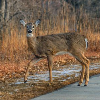
North Dakota's Game and Fish Department will conduct its annual spring aerial mule deer survey from April 1–24 in western North Dakota. The survey of 24 badlands study areas, ongoing since the 1950s, assesses mule deer population abundance in the region.
The Arizona Game and Fish Department uses science-based research, including collaring and tracking 30+ mountain lions, to inform management decisions about the state's mountain lion population. Dr. Brian Jansen and April Howard lead efforts to understand mountain lion ecology, survival rates, and human-wildlife conflicts, with data showing Arizona's mountain lion population is robust and stable.
Vermont Fish and Wildlife urges drivers to slow down during early spring amphibian migration season, known as Big Nights. The agency encourages reporting road crossings to the Vermont Reptile and Amphibian Atlas and partnering organizations like Bonnyvale Environmental Education Center, The Hartford Salamander Team, and North Branch Nature Center to help assess wildlife passage needs.
The Utah Division of Wildlife Resources provides guidance on safely encountering rattlesnakes this spring and summer. Native Herpetology Coordinator Alyssa Hoekstra emphasizes maintaining a safe distance and understanding rattlesnake behavior to prevent conflicts while recreating outdoors.