
|
Texas research using new GPS technology where no research has been done to examine what no study has explored.
All senses lock on the nesting hen. Beady eyes glare and sharp teeth bare. No, it isn’t a coyote or bobcat, which notably take their tolls. Instead, it’s a raccoon. It’s an opossum. It’s myriad other nest predators waiting to strike.
All across America, predator populations — nest raiders and full-feathered turkey killers alike — are growing. Is this booming world full of toothy critters a leading cause of wild turkey population declines? Imminent research aims to answer that question.
TFT is proud to announce a groundbreaking study on predator impacts on nesting and poult-rearing success.
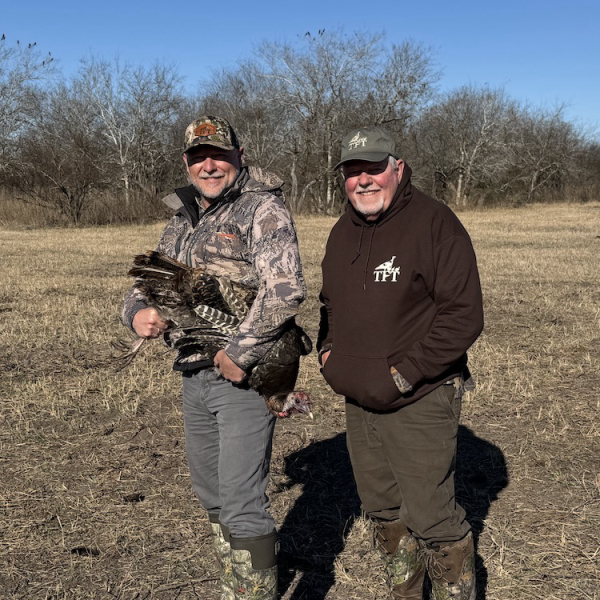
“What’s most important about this effort is that we are radio-tagging Rio Grande hens on a property that has been well-managed for habitat and for reducing predator numbers prior to nest initiation,” said TFT CEO Jason Lupardus.
Along with LSU and Tennessee Tech research arms, in association with Texas Parks and Wildlife (TPWD), and in partnership with Sitka and onX Hunt, TFT hopes to determine the effectiveness of predator and land management in relation to turkey population trends.
This effort is also much in part thanks to Dan Braman, who is a TFT board member (https://turkeysfortomorrow.org/our-team/). He also owns Mellon Creek Outfitters, and a large ranch near Refugio, Texas.
“It’s 115,000 acres, and it also [includes] habitat in scrub country and coastal prairie, where no research on wild turkeys has ever been done,” Lupardus said. “We’re hoping to demonstrate or find that, on well-managed properties where folks are focused on not only habitat but also the reduction of predators that impact ground-nesting birds, we’ll see positive results with our poult recruitment.”
Nicholas Bakner, a post-doctoral research associate at Tennessee Tech University, is collaborating with TFT, LSU, and TPWD, and he’s coordinating work on the ground.
“I’m there for data management and creating reports for everyone to see,” Bakner said. “This is a pilot project. But being on the landscape and seeing it is very interesting. The management [on this ranch] is mind-blowing, but private land is where you’re seeing this management.
“The tags we’ve just put out are on females at a ranch that’s highly managed,” Bakner continued. “It implements prescribed fire, discing, and other types of management strategies, coupled with intense predator management. Finding a ranch that does the combination of these things is really going to provide impactful research on the reproductive ecology of the wild turkey.”
Bakner notes that, much of this type of work has been on landscapes without the combination of predator management and attention to detail on land management. Therefore, he says this will provide a great insight on how valuable these approaches are to the reproductivity of hens.
How does it influence nesting? How does this influence brood success? These questions and more should be answered by this research effort.
“These GPS backpacks collect hourly locations and give valuable insight on where these individuals are roosting,” Bakner said. “We’re able to go out and identify nest locations and track hens during that critical 28-day period when they’re maneuvering the landscape with their brood.”
Interestingly, these GPS units also have accelerometer capabilities. These allow researchers to observe and analyze very specific behaviors of the bird. Bakner labels these as activity monitors, which report on whether the bird is sitting still on the nest, when it starts laying an egg, and when it starts incubating.
“It’s crazy resolution,” Bakner said. “If a bird is on the nest, and a predator comes, you can see the activity amp up and that bird take off from the nest.”
Fortunately, there isn’t much wait time to get things rolling. “We’ll see these GPS transmitters collect in real time,” Bakner said. “Once nesting starts, we’ll have data. I’m hoping to keep everyone updated on what’s happening. So, once breeding season starts, we’ll have maps. It’s going to be very impactful, and hopefully, it’s stuff we can translate into a product for the public landowner and what they can do for wildlife, especially the wild turkey.”
Fortunately, those who wish to play roles in pivotal wild turkey research can do so. Become important contributors to TFT’s ever-growing and already expansive grassroots effort.
“We ask people to become members,” Lupardus said. “Be involved. Look into our private landowner cooperatives. Listen to the Wild Turkey Science podcast (https://turkeysfortomorrow.org/wild-turkey-science-podcast/) to gain more knowledge on what you can do at the local level.
“We’re very excited about this project and many more to come,” Lupardus concluded.
We’ll keep you in the know with updates from the field.
Support TFT
Wild turkey populations are on the decline throughout the nation. Established in 2021, TFT is new to the landscape, but it’s driven by highly trained professionals with decades of conservation experience. To support TFT, and the complete body of wild turkey research and conservation it’s leading, become a member today. An Adult Annual Membership is $50, multi-year Team Turkey Membership is $250, and Life Membership is $2,500. Every dollar counts in the fight for wild turkey preservation.