
 |
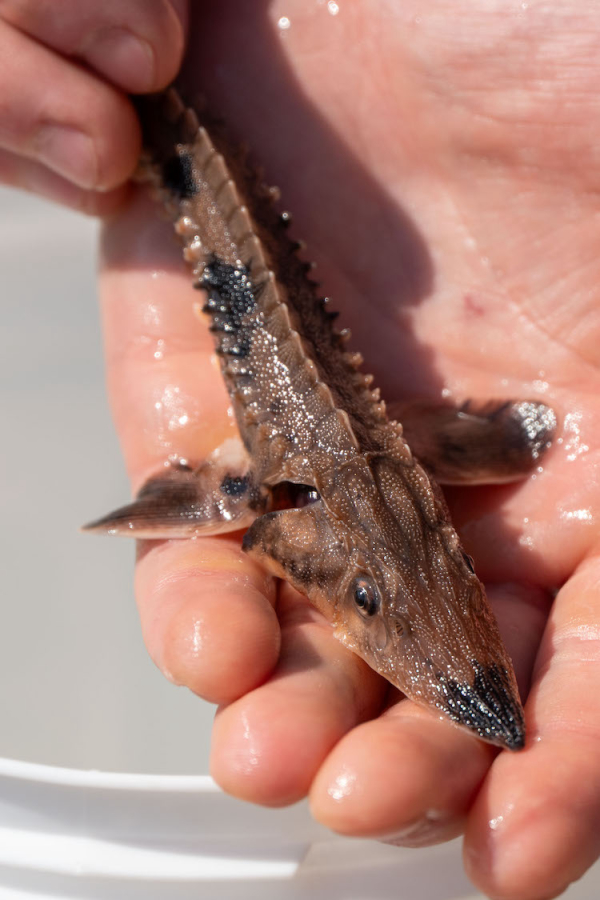
Reintroduction efforts for state-endangered lake sturgeon expanded to the Cuyahoga, Sandusky, and Scioto rivers in 2025, according to the Ohio Department of Natural Resources (ODNR) Division of Wildlife. As part of a large, regional partnership, the 6- to 8-inch-long juvenile sturgeon were released in the Cuyahoga, Sandusky, and Scioto rivers for the first time, as well as in the Maumee River as part of ongoing restoration efforts.
The U.S. Fish and Wildlife Service and the Toledo Zoo reared the fish for release. Two-thousand sturgeon were released in the Cuyahoga River in October as part of a widely attended public event. Also in October, 3,000 sturgeon were released in the Maumee River during Toledo’s annual Sturgeon Fest, while an additional 750 went to the Sandusky River. Finally, 30 juvenile sturgeon were surgically implanted with monitoring tags by The Ohio State University and released in the Scioto River in November.
Lake sturgeon are an endangered species in Ohio. They were once abundant in Lake Erie and the Ohio River, spawning in tributary rivers of those larger bodies of water, but declined over the last 150 years because of dams that blocked access to spawning sites and unregulated harvest. Ohio lost all known spawning populations of lake sturgeon. Following water quality improvements and barrier removals, habitat assessments have demonstrated that the Cuyahoga, Maumee, Sandusky, and Scioto rivers have suitable habitat to support spawning lake sturgeon.
Lake sturgeon are a bottom-dwelling fish that feed on invertebrates and small fish. They are capable of reaching 6 to 8 feet in length and upwards of 200 pounds over their 100-year lifespan, making sturgeon the largest fish in the Great Lakes. Female sturgeon need up to 25 years to reach sexual maturity and only reproduce every few years, meaning species recovery is a long-term project.
Biologists expect lake sturgeon released in the Cuyahoga, Maumee, and Sandusky rivers to travel downstream to Lake Erie, while those released in the Scioto River would move into the Ohio River, with hope that as the fish mature they’ll return to these waterways to spawn.
Since the Division of Wildlife and its project partners began annual lake sturgeon releases in the Maumee River in 2018, fisheries biologists have documented increased numbers of lake sturgeon in Lake Erie. The early signs of success from the Maumee River provide optimism for the Cuyahoga, Scioto, and Sandusky river efforts.
The Division of Wildlife plans to release lake sturgeon in all four rivers in future years to create a viable, reproducing population of lake sturgeon in the Lake Erie and Ohio River watersheds.
Learn more about lake sturgeon at wildohio.gov. This species is protected in Ohio as an endangered species. If you encounter one, please report it at wildohio.gov and release it carefully if caught.
The mission of the Division of Wildlife is to conserve and improve fish and wildlife resources and their habitats for sustainable use and appreciation by all. Visit wildohio.gov to find out more.
ODNR ensures a balance between wise use and protection of our natural resources for the benefit of all. Visit the ODNR website at ohiodnr.gov.