
Trading RVs is a kludge up of relocating, renovating and opening a forgotten storage unit.
You’ll find things you didn’t realize you’d lost.
And that “thing” you knew would make your travels easier, simpler, more comfortable or whatever? In the far corner of the storage locker.
Unopened. If gadgets are your “thing” RVs have ‘em in spades.
You’ll also need to learn another set of eccentricities to run the new unit.
If your old RV required the engine be turned off and the parking brake set to put out slides or extend levelers, the new unit may require the brake to be set, but the engine will need to be running…. unless you want to open the awning. For that, you’ll need to turn everything off required to be running before.
Don’t forget to reverse the procedures—in exact order—when it’s time to break camp.
You’ll learn which gauges offer “suggestions” instead of “measurements.” And while RV builders apparently believe labels differentiating between adjacent potable inlets and non-potable outlets are unnecessary, but you will know better.
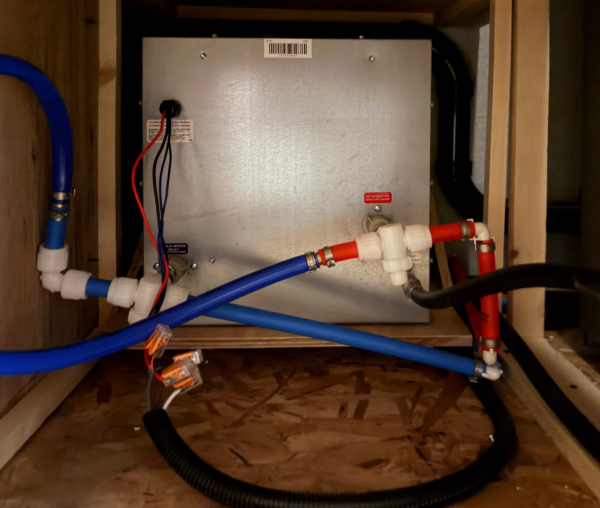
Here’s the thing: every process on any RV is similar, but may be different. It’s why the best RV repair technicians are generalists. There are as many different ways to build and finish the internals of an RV as there are assembly workers in and around Elkhart, Indiana.
Elkhart, for the uninformed, is to RVs what Kitty Hawk, NC, is to flight. If it’s associated with an RV, it originated in Elkhart. If you’re older, you’ll remember Elkhart as the place where virtually all brass musical instruments originated.
The difference between any Elkhart musical instrument and today’s built-by-piece-worker RV is significant.
Musical instruments, whether labeled Selmer, Conn or Bundy, had standardized keys. Same note, same place, every unit.
Had RV assemblers built them, the musical range should be the same, but note placement might vary slightly for each unit.
If Selmer, Conn and Bundy represented orchestral standards, Thor, Forest River, Winnebago and their neighbors would be a violin class of six year olds.
That’s not to say RVs aren’t terrific. They are. They’re just uniquely individual.
We’re just home after 15 days in our new RV with only a couple of minor issues. Primarily due to our lack of familiarity with the eccentricities of our new unit.
RVs might be priced like a handbuilt luxury car, but they’re actually assembly line truck chassis and drivetrains with little houses mounted on them.
Houses, unlike cars or trucks, have internal differences, despite having been built from the same set of plans.
Your house may look identical to a neighbor’s down the street, but…his garage door squeaks because it’s slightly misaligned. Your garage door may be totally silent, but you have a step that squeaks when you step in the middle.
You get the picture? Same plans, same builders, minor differences.
I’ve learned that RVs, like boats and airplanes always have something needing attention.
It is, after all, a house on wheels, with multiple types of plumbing, electrical and heating systems. And anything driven, flown or floated is subject to the shakes, rattles, rolls – and potholes – of use.
Expecting something to need attention, whether it’s aboard your unit, or part of the campground where you’re overnighting. It eases frustration.
Big systems demand attention. If you think otherwise, you may want to reconsider RVing.
The first night of our road trip, we thought power was out to several circuits. Not an optimal start for a long trip. Repeatedly checking circuit breakers and fuses showed no internal issues.
Because there weren’t any. The problem was outside in the campground’s shore power box.
Our RV, sensing insufficient power had routed power (automatically) to key internal systems (HVAC, fridge, slides and such). With insufficient amperage, lesser circuits were omitted.
A plus we didn’t know we had. Along with our external surge suppressor to limit power fluctuations, we had the assurances of safety measures protecting against too-little (inconvenient) or too-much (damaging) power.
Same reason pressure regulators should be mandatory on all incoming water lines. Too little pressure is an inconvenient “thing” at many campgrounds. Too-much pressure can pop water connections inside the RV.
One’s inconvenient, the other very expensive. Choose wisely.
So why spend a considerable amount of money for a pop-up, towable, or Class A, B or C RV - knowing the purchase is, essentially, your opening bid?
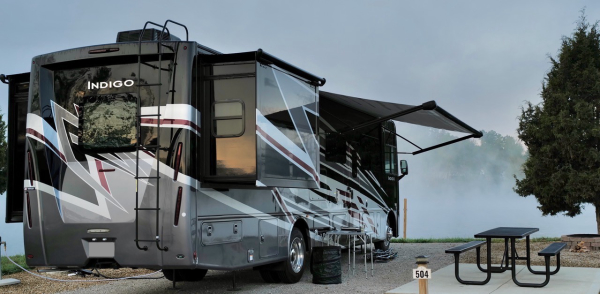


To travel the country without wondering about the quality of accommodations along the way, or whether you brought enough medications, socks, underwear, etc, should you decide to stay a little longer. You packed what you like to wear, prefer to eat and want available should you have the urge to fish, hike or simply sit around a campfire and enjoy nature.
Because the outside really is good for our inside.
We’ll keep you posted.
—Jim Shepherd